2026-03-03

Wrede Club: Some Recent Examples of “Wredegeheimnis” (3)

Creative Commons License
This work is licensed under a Creative Commons Attribution 4.0 International License.

by Tim Widowfield

This post will conclude our analysis of Ian Mills’s arguments against Wrede, presented on Derek Lambert’s MythVision Podcast.

“Faithful” translations

There are no nails or crosses here, only trees.

Before we get to Wrede, I’d like to quote from the Acts of the Apostles. First, from the Contemporary English Version, which proudly claims to be accurate and “faithful to the meaning of the original”:

Acts 5:30 (CEV) You killed Jesus by nailing him to a cross. But the God our ancestors worshiped raised him to life.

The New International Version, which is the most popular English translation in the world, has a somewhat different take on the same verse. Their team claims to translate scrupulously from the original Greek using word-for-word along with thought-for-thought methods.

Acts 5:30 (NIV) The God of our ancestors raised Jesus from the dead—whom you killed by hanging him on a cross.

Readers will no doubt remember this line from Peter’s speech before the Sanhedrin. Here’s another example from Acts 10:39. First, from the Good News Translation, which is still extremely popular. (The CEV and GNT both came from the American Bible Society.)

Acts 10:39 (GNT) We are witnesses of everything that he did in the land of Israel and in Jerusalem. Then they put him to death by nailing him to a cross.

And now the NIV:

Acts 10:39 (NIV) “We are witnesses of everything he did in the country of the Jews and in Jerusalem. They killed him by hanging him on a cross . . .”

Peter is speaking here again. Curiously, the Jews disappear from the GNT and the CEV. We see minor differences, but one thing these verses have in common is the word “cross,” which does not exist in the original Greek. There are no nails or crosses here, only trees. These translations aren’t outliers, either. The New American Standard Bible (“Accuracy you can trust, in the English you speak!”) does it, too:

St. Peter Preaching in Jerusalem LACMA M.81.73 245x300
Peter Preaching in Jerusalem by Charles Poërson, 1642

Acts 10:39 (NASB) “We are witnesses of all the things He did both in the land of the Jews and in Jerusalem. They also put Him to death by hanging Him on a cross . . .”

What’s going on here? The translators have decided in these cases to substitute the word-for-word method with thought-for-thought. They presume to know what the author was really thinking, so they’re “fixing” (amplifying?) the text for modern English readers.

Acts 10:39 (SBLGNT) καὶ ἡμεῖς μάρτυρες πάντων ὧν ἐποίησεν ἔν τε τῇ χώρᾳ τῶν Ἰουδαίων καὶ Ἰερουσαλήμ· ὃν καὶ ἀνεῖλαν κρεμάσαντες ἐπὶ ξύλου.

And we [are] witness of all [the] things he did in both the region of the Jews and [in] Jerusalem, whom also they put to death having hanged [him] on a tree.

I bring all this up, because a great deal of New Testament oddness remains hidden by our “accurate” English translations. The faithful translators will, of course, insist that tree is just a poetic synonym for cross. Do we really know that?

Diversity of Thought in the New Testament

They see themselves as faithful to the text, but they are faithful first to their conception of the Bible. That conception starts from the belief that the Bible is the inspired word of God. Here in the rural Midwest, we see billboards that ask “What does the Bible say about . . . ?” These questions reveal the foundational dogma that the Bible has a unified message at its core. The unspoken question for the faithful is “What is the Bible supposed to say?”

The translators of the NIV and CEV feel free to add “missing” words. In the Gospel of John, both translations add “pray” and “prayer” where they don’t exist in the Greek. In the same Gospel, the CEV actually adds the missing name of Jesus’s mother (see 2:1). Did the author of John know her name was Mary? Perhaps. But he never wrote the name.

Today’s NT scholars do admit that some diversity of thought exists in the New Testament. However, the extremely conservative British and American scholars of the early twentieth century were far less tolerant of such notions. When Wrede pointed out passages in scripture that strongly suggest various authors had divergent ideas about when Jesus became the Messiah, they were not amused. But Wrede went further. He said such divergence indicated an evolution of ideas:

  • Jesus became the Messiah at his death (Paul)
  • Jesus became the Messiah at the baptism (Mark)
  • Jesus was the preexistent Son of God (John)

Moreover, Wrede pointed out that our earliest Gospel is a mixture of Mark’s dogmatic invention along with received tradition, and he showed that the author was neither an eyewitness nor a disinterested historian. Finally, his somewhat favorable references to F. C. Baur and D. F. Strauss were certainly more than any self-respecting scholar could allow.

So we shouldn’t be surprised that pious Brits and Yanks savaged Das Messiasgeheimnis and its author, or that the book wasn’t translated into English until 1970. The tradition of reading and opining about Wrede, while diligently not reading Wrede has a long, proud history.

“The meaning of the item”

Mark had an entirely different view of what it meant to be the Messiah.

If they had read Wrede, they would have discovered that he identified a number of core problems with critical scholarship of the nineteenth century. Many of these problems persist.

In the affirmative answer to this question if Jesus was “the Christ, the Son of the Blessed” the high priest discerns blasphemy—and therefore a crime punishable by death. The blasphemy is usually thought to lie in arrogation to himself by a puny, weak and powerless man of the highest dignity known to Israelites, that of the Messiah sent by God. The tacit or explicit assumption behind this is that if the blasphemy lay in the pretension to divine glory and divine nature, Jesus like the high priest would have been taking the title “Son of God” to have a dogmatic, metaphysical sense and this is historically an impossibility. But to argue in this way is as dangerous as it is frequent. We must never say that if a particular item meant one thing it would not match up with the history of Jesus and that therefore it must mean something else. The meaning of the item is rather the prior question at all times. What history can make of it comes into consideration later. (Wrede 1901/1970, pp. 74-75, bold emphasis mine)

In a literary analysis especially, “the meaning of the item” must go back to the author, not to some imagined historical context. People still make this mistake. They gloss over the surface and look for what lies beneath. They leapfrog over the plain meaning of the text and evaluate matters as if they really happened, and they compare critically the terms Mark uses against the “normative” definitions found in other texts from roughly the same period.

As Wrede explains, calling oneself the Messiah would not constitute blasphemy. He writes:

[T]he mere assertion of messiahship does not, according to Jewish ideas, amount to blasphemy. But it is not any easier to see how a Christian author could find an instance of blasphemy here if he had only the Jewish idea of Messiah in mind. For when all is said the Messiah is not in Jewish eyes a divine being. On the other hand, if Mark understood “Son of God” in a supernatural and metaphysical sense, everything becomes quite clear. (Wrede 1901/1970, p. 75, bold emphasis added)

Many scholars have chastised Wrede for putting too many things under the umbrella of messiahship. Why keep healings and exorcisms a secret, they ask, when being acknowledged as some sort of wonder-worker doesn’t make a person the Messiah? Similarly, they note that nobody would have thought a Jewish Messiah would suffer, die, and be raised from the dead. Well, yes. That’s what Paul said: The claim that the Messiah had died was a “stumbling block” to the Jews. But Mark had an entirely different view of what it meant to be the Messiah.

Ian Mills’s Critique of Wrede’s Solution

Let’s finally return to the Myth Vision podcast with Ian Mills. As we learned last time, he says almost nobody agrees with Wrede today. In fact, at around 6:40, he says, “It’s a bad theory.” Continue reading “Wrede Club: Some Recent Examples of “Wredegeheimnis” (3)”


2026-02-16

Wrede Club: Some Recent Examples of “Wredegeheimnis” (2)

Creative Commons License
This work is licensed under a Creative Commons Attribution 4.0 International License.

by Tim Widowfield

In this post, we’ll examine the arguments against Wrede presented by Ian Mills on Derek Lambert’s Mythvision Podcast. I’ll start with a list of things he gets right, and then we’ll see where he flies off the rails.

What Ian Gets Right

      • John S. Kloppenborg: “The spell of Mark would not be broken until Wilhelm Wrede demonstrated that the ‘messianic consciousness’ that was so fundamental to the liberal lives was a creation of Mark (Wrede 1901; ET 1971).” (p. 12) [Note: Wrede said it was not a creation of Mark.]
      • Candida Moss: “In 1901, William Wrede argued that these sayings form part of a ‘Messianic Secret’ in Mark in which the identity of Jesus is concealed in order to explain how Jesus came to be crucified (Wrede 1971).” (see p. 247). [Note: Wrede said it arose within the tradition in order to explain why no one knew Jesus was the messiah before the resurrection.]
  • He pronounces Wrede correctly. I recently watched a short (slightly over 3-minute) YouTube video, and at least for the time being I won’t link to it here. Suffice it to say, when the professor in the video pronounced Wrede as “VAIR-duh,” my jaw dropped. I watched the longer, related video behind a paywall, and I can confirm that it was not a momentary lapse.
  • He says that Wrede identified a persistent motif of secrecy that is found chiefly in Mark.
  • He rightly believes that Wrede’s methodology was the forerunner of literary-narrative approaches to the Gospels.
  • He says Wrede is the forefather of redaction criticism.
  • He correctly identifies (at least partially) Wrede’s solution: The historical Jesus never claimed to be the Messiah. (5:32)

All of this is encouraging. He’s off to a good start.

What Ian Gets Wrong

Problems begin at 4:00. He says that almost no one agrees anymore with Wrede’s solution. That may or may not be true, but what does he think Wrede’s solution is? This is extremely important, because if we don’t know what Wrede actually said — if we get it wrong — then our criticisms of the solution are useless. We are arguing with a Wrede of our own construction.

I’ll quote directly from the video. (YouTube’s transcript is immensely useful here.) Continue reading “Wrede Club: Some Recent Examples of “Wredegeheimnis” (2)”


2026-02-13

Wrede Club: Some Recent Examples of “Wredegeheimnis” (1)

Creative Commons License
This work is licensed under a Creative Commons Attribution 4.0 International License.

by Tim Widowfield

Why is this important?

If we want an honest discussion about what Wrede got wrong or right, we need to know what he really said. Scholars often make two variations on the same mistake.

1. Claiming Wrede said something  he actually never said.

2. Claiming Wrede failed to say something that he actually did say.

An honest discussion cannot arise from incorrect baseline data.

This post isn’t part of the series, “Reading Wrede Again for the First Time,” but is more or less an excursus on the state of deficient scholarship surrounding William Wrede and the Messianic Secret (das Messiasgeheimnis). I’m trying out the term Wredegeheimnis to describe the hidden or “Secret Wrede” in modern NT studies.

We’ll take a closer look at some recent examples. By the way, I don’t expect things to improve in Wrede Club. I’m not a scholar, just a guy who reads.

Reigning Champion: Wikipedia

Yes, I fully support the concept of Wikipedia, but I recognize that its execution often falls short of its potential. Wikimedia is part of the overall universe of free and open discourse, which is important now more than ever. However, the article on the Messianic Secret is a complete dog’s breakfast. I will highlight some of the more egregious mistakes below.

♦ How Did the Secrecy Motif Originate?

Wrede suggested that this theme was not historical but was an addition by the author of Mark. [Main topic, para. 2] 

No. Wrede held that the author of Mark is not responsible for the theme. It was present in the sources that he had at his disposal. I must point out here that the German Wikipedia page on the Gospel of Mark gets it right.

Das Messiasgeheimnis ist eine von William Wrede erstmals als dogmatisches Konstrukt erkannte Theorie des Markusevangeliums. Er schrieb dieses jedoch der vormarkinischen Tradition zu und benannte drei Elemente dieser Theorie: Schweigegebote an Dämonen, Geheilte und Jünger, Unverständnis und Unglaube der Jünger und die Parabelbelehrung.

The Messianic Secret is a theory of the Gospel of Mark first recognized as a dogmatic construct by William Wrede. However, he attributed it to the pre-Markan tradition. He named three elements of this theory: commands of silence to demons, healed people, and disciples; the disciples’ lack of understanding and their unbelief; and his teaching in parables. (My translation, emphasis mine)

As an aside, the Encyclopaedia Britannica also gets it wrong.

According to Wrede, Mark’s solution was: Jesus always knew it but kept it a secret for the inner group. (emphasis mine)

That’s incorrect. It was never “Mark’s solution.” According to Wrede, there were at least two strands of tradition available to the author of Mark: one in which Jesus keeps his Messiahship a secret, and another in which everyone knows he’s the anointed Son of God. (Wrede also points to another source of tension against the Messianic Secret tradition, namely the fact that the author’s purpose for writing the Gospel is to prove Jesus was the Messiah! We’ll look at this point more closely in a future post.)

♦ Did Wrede Renounce Markan Priority?

…Mark was the source for Luke and Matthew. There are indeed very strong reasons for this. I will mention a few. [Wrede 1907]

The Wikipedia authors declare:

Wrede’s theory had an inherent inter-relationship with the hypothesis of Markan priority, which Wrede eventually abandoned, but some of his followers accepted. [Main topic, para. 3] 

Wrede never abandoned the concept of Markan priority. The authors of this paragraph on Wikipedia have misread and cited Christology and the Synoptic Problem by Peter M. Head. They may have been confused by this sentence: Continue reading “Wrede Club: Some Recent Examples of “Wredegeheimnis” (1)”


2026-02-06

Reading Wrede Again for the First Time, Part 12

Creative Commons License
This work is licensed under a Creative Commons Attribution 4.0 International License.

by Tim Widowfield

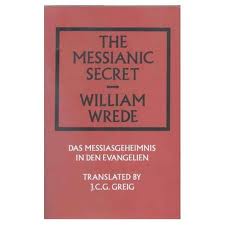
William Wrede’s The Messianic Secret

Part 12: Secrecy in the Gospel of John

I can hardly believe that my last post in this series appeared here a decade ago. Yes, I knew I hadn’t finished, but never underestimate the power of inertia. Oddly enough, a random YouTube video caused me return to Wrede (and the scholars who don’t read him). Apparently, YouTube’s algorithm noticed I was searching for New Testament videos, and it showed me an NT Pod episode from the lovely Mark Goodacre.

Over that past decade, I haven’t exactly abandoned New Testament studies, but I have spent the bulk of my time reading modern history — mostly books about critical eras, like the decades leading up to the Russian Revolution and the American Civil War. This year, if time permits, I would like to write about these “pregnant” periods in history here on Vridar.

The first rule of Wrede Club is: Nobody reads Wrede

WREDE CLUB  300x182The fact that Goodacre published a book about John’s obvious familiarity with the Synoptic Gospels is great news. I especially love the provocative title: The Fourth Synoptic Gospel. Longtime readers of Vridar will know that Neil and I have often written about how and why John rewrote the Synoptics, especially Mark. And here’s a bonus: The book contains a section entitled “The Revelation of the Hidden Messiah.” He’s referring to the Messianic Secret! Hence, we have two of my favorite subjects inside one dust jacket.

So you can imagine my disappointment when I read the following line:

There is, however, something still more fundamental. John shares with the Synoptics the same literary conceit, that the story is one in which Jesus’s identity is hidden, only to be retrospectively understood in the light of the resurrection. Just as Kähler’s “passion narrative with an extended introduction” gets forgotten when it comes to John, so too William Wrede’s Messianic Secret is usually remembered as a study of Mark’s Gospel alone. (Goodacre 2025, p. 38, emphasis mine)

This statement somewhat improves on what he wrote in his earlier article in John’s Transformation of Mark.

There is, however, something still more fundamental. John shares Mark’s basic literary conceit that the story is one in which Jesus’ identity is hidden only to be retrospectively understood after the resurrection. Just as Kähler’s ‘passion narrative with an extended introduction’ gets forgotten when it comes to John, so too William Wrede’s Messianic Secret is all too often focused solely on Mark. (Goodacre 2021, p. 86, emphasis mine)

In his original statement, Goodacre implied that Wrede focused solely on Mark; however, upon further reflection (presumably), he said he’s merely remembered that way. And it’s a false memory. Consider how strange it would be to criticize a book originally entitled Das Messiangeheimnis in den Evanglien (plural) for concentrating “solely on Mark.” Note that the original German text spans about 300 pages, and close to half of those pages focus on the other three canonical Gospels. Wrede’s chapter on the fourth Gospel runs 27 pages, which is not insignificant.

Why am I disappointed? Because that’s it. Wrede wrote a book about the Messianic Secret. Yada-yada-yada.

yaddaSo, what sorts of insights and conclusions did Wrede come to after analyzing John’s Gospel through the lens of secrecy and “hiddenness”? How did the secrecy motif evolve through Matthew then Luke, and finally to John?  How did Wrede compare John to Mark? Goodacre doesn’t say. As is so common in modern NT Studies, we are given the “that,” but not the “what.” We’re told that Wrede wrote a book about the Messianic Secret, but he stands to the side as a kind of mute witness. Continue reading “Reading Wrede Again for the First Time, Part 12”


2024-01-04

How Did Scholars View the Gospels During the “First Quest”? (Part 1)

Creative Commons License
This work is licensed under a Creative Commons Attribution 4.0 International License.

by Tim Widowfield

I received an email a few weeks ago [4 Jan. edit: make that a few months ago], in which the sender asked some questions that deserve an extended response. If and when I have the time, I will add more to this post, but I at least would like to start with a broad outline of my understanding of the history of life-of-Jesus research — both in the ways it was actually conducted and in the ways it is currently “remembered.”

Here’s the text of the email:

Hello, I am a fan of Vridar, and I found a comment that you posted in an article that you wrote. The article is at https://vridar.org/2014/05/14/what-do-they-mean-by-no-quest/.

The comment that you made is “One thing that struck me recently while reading and re-reading material related to the Quest, including books from the 19th and early 20th century, is how often authors will state matter-of-factly that “of course” the gospels aren’t biographies. This whole gospels == biographies debate seems rather new and not well argued. But since believing that they are biographies is useful for their narrow purposes, it has become the consensus position among today’s scholars.”

I have a few questions regarding this comment.

1. What books from the first Quest, say plainly that the gospels aren’t biographies?
2. Do they know of Greco-Roman biographies?
3. Do they list reasons why they aren’t biographies?
4. How is the current understanding not well argued?

Thank you for taking the time to read this. I am eagerly anticipating your response.

Before continuing, I just want to say I’m stunned that nine years have passed since I wrote that post. Where does the time go?

What Biography?

First of all, the general consensus in the 19th century held that the canonical gospels contained biographical material, but were obviously not like modern biographies. Many modern scholars who write on this subject annoyingly imply that this assessment is somehow new. Nobody thought that was the case, and nobody confused popular biography or hagiography or legendary biography with modern biography.

The question was simply: Can we use the materials at hand — namely, the aforementioned biographical material — to create a broad historical outline of Jesus’ life. In some cases, they referred to such a sketch as a “historical biography” or “scientific biography.” However, as we know from reading Albert Schweitzer and William Wrede, the authors of these “lives of Jesus” made two fatal errors: (1) assuming that Mark, as the first written gospel, could be trusted as an unbiased historical account, and (2) psychologizing Jesus far beyond the limits of reasonable conjecture.

What Quest?

Holy Grail Tapestry  The Arming and Departure of the Kniights 300x195
Holy Grail Tapestry

Second, the somewhat sensational title of the English translation of Schweitzer’s A History of Life-of-Jesus Research, (Eine Geschichte der Leben-Jesu-Forschung), colors the way we perceive the task at hand. You may suspect that I’m overstating the case, but I think this change of focus is crucial. In the original German, the title — and in fact, the entire work — centers on the scholars and their research. Schweitzer had intended the original title, Von Reimarus zu Wrede, as the attention grabber, but in subsequent editions it was dropped in favor of the subtitle, and in the German world is referred to as History of Life-of-Jesus Research (without the indefinite article).

In English, the very word “quest” evokes a kind of mystic medieval landscape — a verdant, rolling countryside populated with devout knights-errant finding venerated objects, killing mythical beasts, fighting rivals, and saving damsels in distress. In this case, the aim of our quest is not piety or glory, but instead the Jesus of history. Schweitzer’s survey of scholarly research has thus become a romantic historical mission. Continue reading “How Did Scholars View the Gospels During the “First Quest”? (Part 1)”

2021-01-06

What Is the Purpose of the Nicodemus Stories in John? (Part 1)

Creative Commons License
This work is licensed under a Creative Commons Attribution 4.0 International License.

by Tim Widowfield

Longtime Vridar readers may recall a post from 2013 in which I discussed an argument put forth by William Wrede regarding the priority of Mark’s gospel. Wrede noted that when Matthew took over Markan accounts, he sometimes condensed or rewrote his source, which led to oddities in the finished product. It turns out Volkmar and Wrede described this evidence of “inaptness” of the text well before Mark Goodacre discovered editorial fatigue.

Editorial Clues in the Burial Story

joseph and nicodemus 300x200
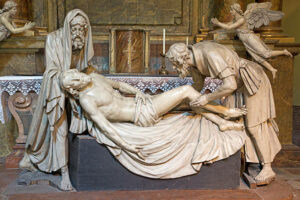
Vienna – Plaster statue of Burial of Jesus with the Nicodemus and Joseph from Arimathea in Michaelerkirche, Vienna.

In a similar fashion, in a post back in 2018, we considered the possibility that a grammatical error in Mark 8:27-30 might indicate a redactional seam that may hold clues to the original (hypothetical) source material. Recently, I became interested in whether such inconcinnities might be found in the narrative layer of the Fourth Gospel. Specifically, I wondered if we might find hints in the empty tomb story of editorial fatigue, which could have been caused by the intrusion of the Nicodemus legend in the burial story.

Recall that Mark’s burial story neatly pre-answers several continuity questions posed by the women-at-the-tomb story.

  1. Q: Why did the women wait until Sunday morning?
    A: Jesus died and was buried on the Day of Preparation (Mark 15:42). They rested and waited on the Sabbath.
  2. Q: Why were they bringing spices to anoint Jesus’ body?
    A: Joseph of Arimathea had quickly wrapped the body and buried it in a tomb. (Mark 15:46)
  3. Q: Who’s this Joseph guy?
    A: A member of the Sanhedrin who was seeking the Kingdom of God. (Mark 15:43)
  4. Q: So Pilate just gave him the body? How did that happen?
    A: He was really brave. He demanded it, and Pilate relented. (Mark 15:43-45)
  5. Q: If the women didn’t participate in the burial, how did they know where to find the tomb?
    A: They followed Joseph and watched from a distance. (Mark 15:47)

The Stone

However, as Sunday morning rolls around, we begin to see some substantial inconsistencies in John’s account.

Mark’s attention to detail in the empty tomb story extends to the stone that blocks the tomb. As an afterthought, the women wonder how they’re going to move “the” stone that’s blocking the entrance. What stone would that be? Continue reading “What Is the Purpose of the Nicodemus Stories in John? (Part 1)”


2019-05-15

Alan Kirk: Misremembering Bultmann and Wrede

Creative Commons License
This work is licensed under a Creative Commons Attribution 4.0 International License.

by Tim Widowfield

Alan_Kirk
Alan Kirk

In a recent post, Neil cited a paper by Dr. Alan Kirk called “Memory Theory and Jesus Research.” While Kirk does an adequate job of explaining the current state of play in memory theory, I couldn’t help but notice yet again some misunderstandings in the ways Memory Mavens remember German critical scholarship in general and form criticism in particular. I’ve been putting off this dismally inevitable task, but the time has come to offer some corrections and commentary.

Pale Residues

First, Kirk takes a swipe at William Wrede. He writes:

. . . Wrede’s bifurcation of Markan tradition into surviving elements of empirical history on the one hand and Easter-engendered dogma on the other, with the latter occluding the former, was precursor to the form critics’ model. Of a “historical view of the real life of Jesus,” wrote Wrede, only “pale residues” survive. (Kirk 2011, p. 809-810, emphasis mine)

Kirk argues that the form critics, taking their cue from Wrede, believed memory and personal eye-witness recollections were synonymous and that the Jesus traditions which effectively buried those recollections were something entirely different.

While memory traces of this sort lay at the origins of the tradition, they were a residuum, largely inert with respect to developments in the tradition itself. The salient image was of so-called authentic memories of Jesus coming to be buried under multiple layers of “tradition.” Tradition, in other words, had little to do with memory. (Kirk 2011, p. 809)

How does Kirk’s analysis square with what Wrede actually said? Kirk’s wording may lead the casual reader to infer from the first citation above that Wrede was referring to the general state of Mark’s sources or, to put in another way, the overall character of the various streams of oral and written tradition available to the author of Mark.

But that would be wrong. Continue reading “Alan Kirk: Misremembering Bultmann and Wrede”


2018-06-03

The Memory Mavens, Part 11: Origins of the Criteria of Authenticity (4)

Creative Commons License
This work is licensed under a Creative Commons Attribution 4.0 International License.

by Tim Widowfield

After a long delay, owing to intrusions from the real world, I now wish to end this part of the Memory Mavens series with a discussion of perspectives and methods. For weeks I’ve ruminated over these subjects, concerned (no doubt overly concerned) that I will miss some important points. But when I do, I know I can return to them in the future. Such is the privilege of blogging.

Historical fads

HeikkiRaeisaenen 208x300
Heikki Räisänen
1941 – 2015

Recently, while re-reading the introductory chapters to Heikki Räisänen’s The “Messianic Secret” in Mark’s Gospel, it struck me how little has changed in NT scholarship. Fads may come and go (does anyone even bother with rhetorical criticism today?), but we can always count on a sizable number of scholars to solve every problem in NT studies with a historical explanation that goes back to the “actual” words and deeds of Jesus.

William Wrede, as you will recall, addressed two problems: (1) What are the origins of the secrecy (or silence) motifs in Mark’s gospel? (2) Did Jesus think he was the Messiah, or did his disciples assign that role to him after they became convinced he had been raised from the dead? Wrede concluded that we could gain important insights into the second problem by solving the first.

By painstakingly examining each case of secrecy — silencing demons, warning people not to publicize his miracles, etc. — against contrary cases in which no such admonition is given, Wrede demonstrated that both openness and secrecy existed in Mark’s sources. He then set about to determine which traditions came first. If the historical Jesus openly proclaimed his status as the Son of God, the Messiah, the savior of Israel, etc., then it becomes exceedingly difficult to explain how the secrecy motif arose. But if Jesus did not publicly proclaim his messiahship, then we can imagine a transitional post-Easter belief (that Jesus and his disciples kept it a secret until his death and resurrection. Which is more likely?

Scholarly backlash and a volcanic Jesus

In the immediate backlash, scholars furiously accused Wrede of hyper-skepticism. As you recall, Albert Schweitzer entitled a chapter in The Quest of the Historical Jesus, “Thoroughgoing Scepticism and Thoroughgoing Eschatology.” He changed his mind, but nobody in the guild seems to care. Although scholars will pretend to have read Wrede’s Secret and Schweitzer’s Quest, the latter is the only one that’s actually on their bookshelves. And sadly, none of them seems to have caught up with the changes made in the second edition (published in 1913).

Schweitzer, along with Wrede, criticized the appalling excesses and flights of fancy which many life-of-Jesus scholars had fallen into. But Schweitzer was not immune to the allure of romantic historicization. Continue reading “The Memory Mavens, Part 11: Origins of the Criteria of Authenticity (4)”


2018-03-14

When Schweitzer Changed His Mind and Nobody Noticed

Creative Commons License
This work is licensed under a Creative Commons Attribution 4.0 International License.

by Tim Widowfield

Zemanta Related Posts Thumbnail
Albert Schweitzer

Recently, I was researching and preparing for the fourth chapter of the most recent Memory Mavens post. I wanted especially to resurrect, and then dismiss, Albert Schweitzer’s characterization of William Wrede’s work as “thoroughgoing scepticism.” I had already touched on this subject back in 2012 in our series on the Messianic Secret.

At the time, I quoted Wrede himself in his defense of reasonable skepticism.

To bring a pinch of vigilance and scepticism to [the study of Mark’s Gospel] is not to indulge a prejudice but to follow a clear hint from the Gospel itself.

In order to explain and defend Wrede’s method it seemed reasonable to me to compare it to Schweitzer’s (as Schweitzer himself had done, over 100 years ago). But then a funny thing happened. Try as I might, I could not find a single reference to “thoroughgoing scepticism” in the 2001 Fortress Press edition of The Quest of the Historical Jesus.

One of our shibboleths is missing

That seemed more than a little odd. Here is a catchphrase, set in stone within the hushed and hallowed halls of NT scholarship, and yet it was missing in action. Where had it gone? When did it leave?

The paper portion of my library, almost all of it, is miles away from me in a storage facility, so I’ve had to rely on electronic versions of Geschichte der leben-Jesu-forschung. The 1913 edition stored at Hathi Trust is in the public domain, and you should be able to read it, no matter what your country of origin is. (Sometimes Hathi Trust limits viewing to IP addresses from the U.S., because of unsettled copyright issues.)

As you probably already know, the first edition, in German, hit the streets in 1906, and it made a fairly big splash. NT scholarship in the English-speaking world took an immediate interest, which only grew when an English translation became available in 1910. Wrede’s The Messianic Secret would have to wait 60 more years. K. L. Schmidt’s Der Rahmen der Geschichte Jesu is still waiting.

In the first edition, Schweitzer pokes Wrede in the eye with the title of chapter 19: “Thoroughgoing Scepticism and Thoroughgoing Eschatology.” Anglo-American scholars were delighted to see Wrede’s troubling thesis dispatched by such a towering, highly respected, intellectual figure. Who could ask for more?

Digging for nuggets, but not too deeply

Of course, Schweitzer’s magnum opus is, other than the Bible itself, the ultimate quote mine for English-speaking biblical scholarship. Certainly, no other modern work is so frequently quoted yet so rarely read. The Quest quickly became an indispensable quarry for scholars who are far too busy to read Reimarus, Strauss, Renan, or Wrede. Half-hearted, indifferent, indolent excavators have continued even into the late 20th and early 21st century, as this simple Google Books search demonstrates.

Consider the following examples: Continue reading “When Schweitzer Changed His Mind and Nobody Noticed”


2018-02-27

The Memory Mavens, Part 11: Origins of the Criteria of Authenticity (3)

Creative Commons License
This work is licensed under a Creative Commons Attribution 4.0 International License.

by Tim Widowfield

Ernst Troeltsch
Ernst Troeltsch

In the previous post, I promised to discuss a group of scholars who changed the perspective of biblical scholarship. I was referring to those whom we commonly group into the religionsgeschichtliche Schule. In English we call this the History of Religions School. The German term, religionsgeschichtliche, implies a secular, critical-historical approach toward religion. The reputation of the History of Religions School has not fared well over the past few decades.

A withering review

For example, in Ben Witherington’s scathing review of Robert Price’s Jesus Is Dead, he writes:

In any case, one of the things that movies like ‘The God who is not There’ and the Zeitgeist movie, and Robert Price’s book have in common is a reliance on the old, and now long since out-dated and refuted notions of the Religionsgeschichte Schule [sic] when it comes to the issue of Jesus and the origins of Christianity. It seems that my former Gordon-Conwell classmate, Bob Price, and various others as well did not get the memo that these sorts of arguments are inherently flawed, have often been shown to be flawed, and shouldn’t be endlessly recycled if you want to argue cogently that Jesus didn’t exist and/or didn’t rise from the dead.

What is the Religionsgeschichte Schule [sic], and why is this school now closed? The history of religions approach to early Christianity, and to Jesus himself, involved as its most foundational assumption that the origins of what we find in the NT in regard to Jesus, resurrection, etc. come from non-Jewish culture of various sorts, particularly from Greco-Roman culture, but also (as the Zeitgeist movie was to remind us) from Egyptian sources. In short, anything but an origin in early Judaism is favored when it comes to explaining the NT and Jesus. (italic emphasis Ben’s, bold emphasis mine)

Just for the sake of accuracy, Religionsgeschichte is a noun; religionsgeschichtliche is the adjectival form. He got it right in the title, but muffed it four times in the body of the review. Still, you have to hand it to him; he actually mentioned it. These days, you’d hardly know the History of Religions School had ever existed, and most scholars don’t — other than it was “flawed” and “refuted” and “outdated.” Just learning those pejorative modifiers would appear to suffice, or at least to keep you in good standing within the guild.

When is a school not a school?

We may find it somewhat difficult to describe a school whose members often insisted there was no school. In “The Dogmatics of the ‘Religionsgeschichtliche Schule,'” Ernst Troeltsch explained: Continue reading “The Memory Mavens, Part 11: Origins of the Criteria of Authenticity (3)”


2015-02-19

Reading Wrede Again for the First Time (11)

Creative Commons License
This work is licensed under a Creative Commons Attribution 4.0 International License.

by Tim Widowfield

William Wrede’s The Messianic Secret

Part 11: Luke Abandons the Secrecy Motif

While we may have had to wait until the end of Mark’s story for the denouement of the secrecy gospel, Luke removes all suspense early on with the scene in the Nazareth synagogue (Luke 4:16-30). In The Messianic Secret, William Wrede writes:

Here Jesus reads out the words of Isaiah 61.1f. regarding the anointing for messianic vocation and then goes on to say, “Today this scripture has been fulfilled in your hearing”. But this is nothing other than a messianic self-proclamation, and if Luke in all probability made up this scene himself in so far as it is at variance with Mark, and certainly thought of it as an introduction determining the character of the presentation of the story which follows, yet one gains the impression that here he is doing something which Mark would hardly have done. However many contradictions may be found in Mark along with the idea of secret messiahship, this is on a different footing. It looks like a denial of the idea itself. (Wrede, 1901/1971, p. 178, emphasis mine)

Jesus is considered by scholars such as Weber ...
The Sermon on the Mount (Photo credit: Wikipedia)

Is the Sermon on the Mount private instruction?

Luke’s Jesus does not hide his light under a bushel. He lets everyone know who he is. We can see the extent to which Luke has embraced this public, openly messianic Jesus even in the way he teaches the crowd.

Wrede makes the point that in Matthew, much of the instruction Jesus imparts to his disciples remains private. The Transfiguration, the prophecy of the passion, the meaning of parables, the “question about the last things,” etc. happen away from the crowds and sometimes away from the majority of the disciples. But that’s not all.

We may also mention that even the Sermon on the Mount is regarded as instruction of the disciples. For according to 5.1, when Jesus sees the crowds, he goes up the mountain and then the disciples approach him[*] in order to receive his teaching. This, of course, is again forgotten at the end of the sermon in 7.28.

[*] prosēlthan autō hoi mathētai, Matthew is very willing to say, even although they were already together with Jesus. Proserchesthai [coming near to, approaching] is generally used by him more often than in all the other New Testament writings put together. (Wrede, 1901/1971, p. 178)

In other words, Jesus is moving away from the crowd and up the mountain where he will give private (secret?) instruction. Apologetic and traditional commentators haven’t seen it that way, of course. Instead of retreating, they imagine that Jesus is simply getting a better vantage point from which to address the crowd. But the text is quite clear. Continue reading “Reading Wrede Again for the First Time (11)”


2014-05-14

What Do They Mean by “No Quest”?

Creative Commons License
This work is licensed under a Creative Commons Attribution 4.0 International License.

by Tim Widowfield

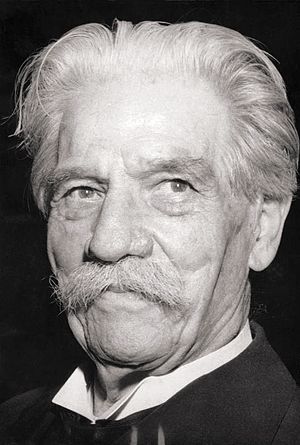
Albert Schweitzer, 1952
Albert Schweitzer, 1952 (Photo credit: Wikipedia)

Dazed and confused

As you no doubt recall, scholars frequently divide the quest for the historical Jesus into phases or periods. The first period, following Albert Schweitzer‘s analysis, began with Hermann Samuel Reimarus and ended with William Wrede and Schweitzer himself. Conventional wisdom holds that the quest took a breather at that point, with scholars somewhat shell-shocked by the implications of the works by Wrede, Schweitzer, and Karl Ludwig Schmidt.

This same conventional wisdom marks the beginning of the “Second Quest” (or, at the time, “New Quest”) in the early 1950s with Ernst Käsemann’s lecture, “The Problem of the Historical Jesus” (published in Essays on the New Testament). The supposed hiatus between Schweitzer and Käsemann is sometimes called the period of “No Quest.”

Miffed scholars

Recently, just out of curiosity, I was Googling “no quest”, and I found several references to indignant conservative and not-so-conservative biblical scholars. They just don’t like that term. It’s dishonest, they insist, and if it’s one thing they can’t stand, it’s dishonesty.

Are they right? And if the pause or moratorium in the first half of the 20th century is a myth, then where did the idea come from and why does it persist?

A “No Quest” period?

First of all, here’s the typical description we get from survey courses and books on the Quest. The front matter for the Fortress Press “First Complete Edition” of The Quest of the Historical Jesus contains Marcus Borg’s “An Appreciation of Albert Schweitzer,” which ends with the following paragraph:

[Schweitzer’s] claim that historical Jesus scholarship has no theological significance has been very influential, contributing to a relative lack of scholarly interest in the historical Jesus for a major portion of this [i.e., the 20th] century. His work was thus not only the highwater mark of the “old quest” for the historical Jesus, but brought the quest to a temporary close. Only in the past few decades — with the “new quest” of the 1950s and 1960s and the “third quest” of the 1980s — has substantial interest in the historical Jesus revived. (Quest, p. ix, emphasis mine)

Gerd Theissen and Annette Merz (The Historical Jesus, A Comprehensive Guide) divide the quest into five phases in which two phases comprise the First Quest. Hence for them “No Quest” is the Third Phase, which they describe as “the collapse of the quest of the historical Jesus.” (Theissen and Merz, p. 9)

“Just not true”

Next, here’s a response from an offended, “anti-no-quest” scholar. In his essay, “The Secularizing of the Historical Jesus” (link downloads the PDF), Dale Allison complains about N.T. Wright’s characterization of the first half of the last century as experiencing a “moratorium” on the quest:

Continue reading “What Do They Mean by “No Quest”?”


2014-02-12

The Author of Mark: Master of Suspense?

Creative Commons License
This work is licensed under a Creative Commons Attribution 4.0 International License.

by Tim Widowfield

English: Studio publicity photo of Alfred Hitc...
English: Studio publicity photo of Alfred Hitchcock. (Photo credit: Wikipedia)

What Is Suspense?

A.H. [Alfred Hitchcock] In the usual form of suspense it indispensable that the public be made perfectly aware of all the facts involved. Otherwise there is no suspense. (Truffaut: Hitchcock (1983), p. 72, emphasis mine)

Back when I was an undergrad at the University of Maryland at College Park, I took a film class that focused on British director Alfred Hitchcock. Our main text, based largely on interviews that you can listen to at the Internet Archive, was Francois Truffaut’s book, which I still highly recommended for any film buff.

The difference between suspense and surprise

Hitchcock, of course, had a keen interest in suspense, as distinguished from surprise.

A.H. There is a distinct difference between “suspense” and “surprise,” and yet many pictures continually confuse the two. I’ll explain what I mean.

We are now having a very innocent little chat. Let us suppose that there is a bomb underneath this table between us. Nothing happens, and all of a sudden, “Boom!” There is an explosion. The public is surprised, but prior to this surprise, it is seen as an absolutely ordinary scene. Now let us take a suspense situation. The bomb is underneath the table and the public knows it, probably because they have seen an anarchist place it there.

The public is aware that the bomb is going to explode at one o’clock and there is a clock in the decor. The public can see that it is a quarter to one. In these conditions this same innocuous conversation becomes fascinating because the public is participating in the scene.

The audience is longing to warn the characters on the screen: “You shouldn’t be talking about such trivial matters. There’s a bomb beneath you and it’s about to explode!” (Truffaut, p. 73, reformatting and bold emphasis mine)

Continue reading “The Author of Mark: Master of Suspense?”


2013-09-02

Reading Wrede Again for the First Time (10)

Creative Commons License
This work is licensed under a Creative Commons Attribution 4.0 International License.

by Tim Widowfield

William Wrede’s The Messianic Secret

Part 10: How Matthew and Luke changed Mark

The Martyrdom of the Apostle St.Matthew
(The evangelist prepares for the final cut.)
Jan de Beer (c.1530-1535)

Five months have passed since my previous post on The Messianic Secret. In the interim, I have focused on material related to the genre of the gospels, which has consumed most of my attention.

Recently, however, I’ve been simultaneously reading or re-reading several works on the problem of the Synoptic Gospels, including E.P. Sanders’ The Tendencies of the Synoptic Tradition, William Farmer’s The Synoptic Problem, and Mark Goodacre’s The Case Against Q. I’ve learned much from reading each of these authors, but I would like to point out that we often will not necessarily understand what is important or significant until we read a work the second or third time.

Let me explain further. About a month ago I began reading The Synoptic Problem by William Farmer, and much to my surprise I learned quite a bit about how we arrived at the “Two-Source” (Mark and Q) consensus — things I didn’t pick up from reading Streeter or anyone else, for that matter. Farmer’s perspective gave him free rein to look for inconsistencies, bad logic, and questionable motives. I now feel the need to go back and re-read The Four Gospels with this new information in mind.

Reading Sanders and Goodacre (again) helped change my perspective on the problem. And as luck would have it, reading Schmidt’s The Place of the Gospels in the General History of Literature as well as the later chapters of The Messianic Secret forced me to re-evaluate those thorny questions.

Synoptic questions

The basic questions we ask ourselves concerning the Synoptic Problem — once we admit that the first three evangelists were somehow copying one another — are:

  1. Who copied whom?
  2. Who changed what?
  3. Why did they change it?

In order to mount a convincing argument as to which gospel came first we need some set of criteria that convincingly explains why an author would change his source material. That is, can we detect any editorial tendencies of an author that caused him to truncate or expand a story? What theological preconceptions might cause a later author to gloss over “difficult” or “uncongenial” passages?

Wrede tackled these sorts of questions in Part Two, “The Later Gospels: Matthew and Luke.”

A primary question will then have to be how the Markan material we have examined is treated in both Gospels.(p. 152)

He’s referring to the passages in Mark that deal with concealment and misunderstanding. If, in Wrede’s view, both Matthew and Luke recapitulate much of Mark, taking over his historical sequence (such as it is), then we should be able to acquire a “direct insight into the history of the approach, which is of interest to us.” (p. 152)

In his examination of Matthew’s use of Mark, Wrede closely examined several pericopae, identified the differences, and tried to develop a coherent reason or set of reasons for the author to change his source material. We will look at two of those stories now.

Continue reading “Reading Wrede Again for the First Time (10)”


2013-03-12

Reading Wrede Again for the First Time (9)

Creative Commons License
This work is licensed under a Creative Commons Attribution 4.0 International License.

by Tim Widowfield

William Wrede’s The Messianic Secret

Part 9: Concealment Despite Revelation

This unit continues with the section of Wrede’s The Messianic Secret (1971 English translation) from pp. 82 through 114, which focuses on the phenomenon of the disciples (and others) seeing or hearing the truth about Jesus but failing to understand that truth.

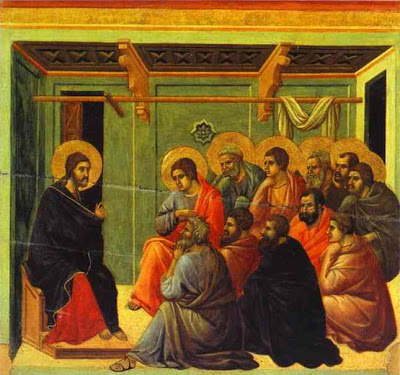
Jesus with the Twelve(Duccio di Buoninsegna)
Jesus with the Twelve
“Are you guys even paying attention?”
(Duccio di Buoninsegna)

Where MacDonald went wrong

Somewhat coincidentally, Neil recently posted a piece called “Where Wrede Went Wrong? MacDonald vs Wrede on Why Jesus Tried to Hide His Identity.” In it, he discussed Dennis MacDonald’s contention that the Gospel of Mark at least in part draws upon narrative motifs from the Odyssey, including the necessity of secrecy as the travel-weary protagonist plots to take revenge against “the Suitors.”

According to MacDonald (see Ancient Fiction and Early Christian Narrative), Wrede mistakenly placed the revelation of messiahship at the resurrection, when the actual revelation occurred earlier. He writes:

This understanding of secrecy [i.e., the one for which MacDonald is arguing] deviates from most other interpretations, including Wrede’s, by proposing that the disclosure of the secret takes place not at the empty tomb but at the Sanhedrin trial. (p. 142, emphasis mine)

While I am amenable to his proposal that Mark at times imitates Homer, MacDonald has failed to understand one of the enigmatic features of the messianic secret. For while self-concealment is a core component of the motif, Mark’s gospel also contains a number of instances in which the true identity of Jesus is plainly revealed to the people around him, and yet the secret remains intact.

By that I don’t mean that certain people “in the know” keep his secret. They hear all, but understand nothing. Only the demons seem to understand the full implications of the true nature of Jesus, and they weren’t told, but already knew it, owing to their supernatural existence.

MacDonald is correct about the disclosure of the secret at the Sanhedrin trial. In fact, from a narrative perspective, it is the turning point that inexorably sends Jesus down the path toward crucifixion. However, as we will see, this instance of disclosure resembles previous occurrences in that understanding does not follow revelation.

Scenes of recognition

The scene in the Odyssey in which Telemachus recognizes his father, MacDonald says, bears a strong resemblance to the scene in Mark wherein Peter “recognizes” that Jesus is the Christ. Interestingly, Telemachus first believes he is in the presence of a god and is frightened nearly out of his wits. At the close of both scenes, the protagonist orders silence. MacDonald writes:

Continue reading “Reading Wrede Again for the First Time (9)”


2013-02-09

Reading Wrede Again for the First Time (8)

Creative Commons License
This work is licensed under a Creative Commons Attribution 4.0 International License.

by Tim Widowfield

William Wrede’s The Messianic Secret

Part 8: A Different Kind of Messiah? — An astonishingly persistent misconception

Get Thee Behind Me, Satan
Get Thee Behind Me, Satan! (credit: Wikipedia)

This unit picks up after our mid-stream break in which we answered the question: “What Is the Messianic Secret?

Restatement of purpose

It is not my main purpose to argue for or against Wrede’s thesis. That isn’t why I’ve embarked on this reading expedition. My reasoning is straightforward: Before we agree or disagree with Wrede, we ought to know what he really said. As I’ve mentioned in earlier posts, The Messianic Secret had a profound impact on NT scholarship. Yet that impact is mostly misunderstood and largely muffled by scholars and laymen who opine on the subject with only the most cursory reference to the actual source material.

I note with some sadness the historical irony here. Wrede continually asked his fellow scholars to stop ignoring Mark. Instead of asking, “Why did Jesus do that?” we first should ask, “What did Mark mean when he wrote that?” Having learned nothing from The Messianic Secret, scholars now ignore both Wrede and Mark.

The vast majority of scholars who talk about the Messianic Secret are clearly ignorant of Wrede’s work. They waste our time by rehashing arguments that Wrede already convincingly addressed and discredited. And they do a disservice to their students and the reading public who get a distorted view of what the Messianic Secret is all about.

A short autobiographical digression

When I left the USAF back in ’92, I ended up working for a consulting company that specialized in information technology (IT) management, and which also dabbled in business process re-engineering (BPR). We became heavily involved in helping the Air Force with the merger of the old AF Systems Command and AF Logistics Command into the combined AF Materiel Command. Specifically, we were to assist them in deciding on a single set of IT standards, methods, processes, etc.

I found myself in the unexpected role of facilitator in round-table discussions, with a group of high-ranking, strong-willed people who had larger-than-life egos. They were all rulers of their fiefdoms, and quite unaccustomed to being told how to run their businesses.

My job was to keep the discussion on an even keel, to make sure everyone contributed to the discussion, and to gently guide the group to a consensus. One of the rules that we followed (and which I enforced) was this: Before anyone could disagree with a previous point, he or she had to restate it to the satisfaction of the person who had made that point. You would be amazed at how well this rule works not only in de-escalating tensions but in saving time.

How does it save time? Well, people don’t hear very well when they think they and their cherished beliefs are under attack. So when Mr. X would speak up and say, “I disagree with Ms. Y, because the real problem with . . .” My job was to say, “Hang on. Explain what Ms. Y said.” Immediately his posture would change. Instead of leaning forward aggressively, he would usually sit back, reflect a moment, and say: “Well, I think she said . . .” The ensuing give-and-take helped to clarify the issues at hand, and more often than not, Mr. X would admit that he had misunderstood Ms. Y. Frequently they found that they were actually in “violent agreement.”

I tell this story to explain why I have such a strong conviction about understanding a work before criticizing it or proposing “better” explanations. The vast majority of scholars who talk about the Messianic Secret are clearly ignorant of Wrede’s work. They waste our time by rehashing arguments that Wrede already convincingly addressed and discredited. And they do a disservice to their students and the reading public who get a distorted view of what the Messianic Secret is all about.

“Don’t get the wrong idea about me.”

I almost hate to bring up Bart Ehrman again as a bad example, because it’s starting to look as if we’re unduly picking on him. He is not uniquely wrong at explaining Wrede; in fact in some respects he’s better than most. However, his assessment of the Messianic Secret motif is very instructive with respect to the idea of “different kinds of messiahs.” In his survey textbook, The New Testament, he summarizes Wrede’s thesis. He misses many of the nuances of Wrede’s arguments, but he’s generally accurate.

However, because Ehrman sees the gospel of Mark as an “ancient religious biography” (see Chapter 4), and because he fails to understand that Wrede’s questions are more about Mark, not the historical Jesus, he finishes his assessment by shooting over the heads of Wrede and Mark, offering the following historical explanation to what is essentially a form-critical question:

Continue reading “Reading Wrede Again for the First Time (8)”