You want to defend the skeptical and atheist community? We’re going to have to face up the fact that the popularity and persistence of terrible people who wave the banner of atheism has already compromised us, and realize that when some of our ‘heroes’ go further and commit sexual harassment, that doesn’t mean that they’re exceptional, but are perhaps more representative than we like to admit. At the very least, we have to recognize that being a misogynistic scumbag does not disqualify you from claiming to be an “amazing” atheist.
Further, that so many atheists insist that no moral stance can be assigned to atheism means that the awful people can not be repudiated as atheists; we can do so as individuals, as human beings, and as humanists, but the lack of any principle but “there is no god” in atheism means there are no grounds for forswearing or dismissing these people within the atheist movement.
So what’s the point of the atheist movement? There is none. It’s killed itself.
Agreed. So when theists mock “angry atheists” I cannot deny that many atheists deserve that charge.
The idea of an atheist movement gives those atheists who do not welcome a tribalist or group mentality are going to be embarrassed by those who do.
Some will say, But hey, look at the encouragement the atheist movement has given to atheists suffering persecution in places like Bangladesh. My reply is that such people would find encouragements in any atheist author in the West or anywhere else. I did not become an atheist because of any “atheist movement” and I suspect the same is true for many others.
An “atheist movement” seems to me to invite a tribalist mentality with all the negatives and intolerant attitudes towards outsiders that that brings.
I am an atheist but for the life of me I cannot see how atheism is any basis for a social community. There are good atheists and bad ones; atheists on the political left and atheists on the political right; classical-music-loving atheists and hard-rock-loving atheists; atheists who loathe anything associated with any religion and atheists who highly respect the religious mindsets of others; atheists who live by conservative moral standards and atheists who are libertine.
If I want to do my bit to help alleviate suffering among victims of a natural disaster or help raise public awareness of the needs of a disadvantaged group, join a political pressure movement or support a charity, I will not do so as an atheist. I will do so because it is the cause that is my prime concern and my atheism, I believe, is irrelevant.
Churches (and government agencies) may well advertise their identity when they send food and medicines to places wracked with famine but I have no interest in exploiting such opportunities to make a statement about my personal belief system. I am sure churches are often sincere when they give but to do so in a way that draws attention to their church identity strikes me as a little compromised. There are few logos apart from that of the International Committee of the Red Cross that I can support.
Last month I wrote what a piece attempting to think through my experience with an online atheist community. I used the term “cult atheism“. On further reflection I wonder if “tribal atheism” or “atheist tribalism” would have been more appropriate. Soon after I wrote that post a number of people informed me that that atheist community site had begun a somewhat heated discussion about me personally. I thought that was strange since so few persons had attempted to engage me in discussion during my time there. So yesterday I finally caught up with that discussion on the AFA site. That’s one more to-do item I can now cross off my list.
Comment: The Vridar Discusses AFA thread seemed to underscore the comparison I made in my earlier post between cultish (should I rather say tribal?) behaviour and that atheist community. Recall in my first post I spoke of excommunication. Let me expand on that. When one is excommunicated from a cult or fundamentalist sect the members pull together and opine on how bad, how “in the grip of Satan”, the banished person both “is” and “always was”. It is as though the one who is excommunicated takes the place of the Azazel goat of the ritual on the Jewish festival of atonement: all the sins of the community are placed on that goat as it is driven into the wilderness.
The same generally (there may be rare exceptions) occurs when a member leaves the fold, willingly, without any formal excommunication announcement. For the group to engage in introspection, to try to examine if their own behaviour may have been at least partly responsible, is rarely part of the script. Rather, the “lost sheep” will be portrayed according to the stereotypes set out in the Bible: they were never truly part of us to begin with; they are in the grip of all sorts of sins; they are in the bond of bitterness; and so on. I find the parallels with the AFA community’s discussion about me after I left the group to be so very familiar.
Anyway, there was one remark made towards the end of that discussion thread that sparked my curiosity. It was suggested that I should have engaged in an “Ask Me Anything” session prior to leaving. Curiosity did get the better of me and I volunteered to do just that and face my accusers and any others also curious. The AFA Forum rules say that “AFA members especially have a duty to portray to the public a disciplined attitude in postings.” We’ll see what happens, if anything.
Part of me would like to try to contribute where I can and no doubt there are many lurkers or members of the forum who do not share the inconsistent and hostile attitudes of a some of the more outspoken voices there. (We’ll see. If anything.)
No doubt some readers are more practised at this sort of discussion and can provide better responses than mine.
Question 1: What would you count as “actual, credible, real world evidence for God?” If the atheist refuses to answer, he/she will be exposed as Hiding the Goalpost, demonstrating the inherent intellectual dishonesty in such a demand. If the atheist finally answers, there is a very, very high likelihood he/she will cite some dramatic, miraculous, sensational demonstration of God’s power. And that leads to the second question.
Response 1: First define what you mean by “God”. Without a clear definition we can hardly proceed with a meaningful investigation.
Response 2: What I would count as evidence for X (whether a particular God or law or event or person or anything) is the setting up of tests or predictions of what we would expect to find in the evidence given that X is true. That is, I would accept any evidence that was derived from the scientific method.
So if our God is one who is defined as the source of all ethical or moral awareness or consciences, then what would we expect to find in the universe that is evidence of this particular type of God?
We would then look for those sorts of things we expect to find if God was the creator of the universe. The scientific method also requires us to test our findings against alternative explanations so we would need to see in each case if there are simpler explanations for the sorts of evidence we find. The same method requires us to look for evidence that contradicts our thesis, too.
Whatever passes these tests would be evidence that God as a source of morality exists.
Question 2: Why would that dramatic, miraculous, sensational event count as evidence for God? At this point, the atheist will likely try to change the topic. But persist with the question. What you will find is that the reason why the atheist would count such an event as evidence for God is because it could not possibly be explained by natural causes and science. In other words, because it was a Gap. Modern day atheism is built on God of the Gaps logic.
Response 3: A hypothesis becomes acceptable when it accounts for the observed data more simply or more comprehensively than any other hypothesis. If our hypothesis of a particular defined God explains data that no other hypothesis can explain, then yes, that God hypothesis is a great advance in our knowledge. But if other hypotheses can explain the data, and a greater range of the data, than the God hypothesis, then other hypotheses “fill the gaps”.
Question 3: Is the God of the Gaps reasoning a valid way of determining the existence of God? If the atheist has not bailed on you yet, he/she will likely run now. For if he/she answers NO, then it will become clear that nothing can count as evidence for the existence of God. Why? Because if the only “evidence” the atheist “Judge/Jury” will allow in his/her kangaroo court is a Gap (something that cannot be explained by science/natural law), and God-of-the-Gaps reasoning is also not allowed by the atheist, then it is clear the atheist demand for evidence is a sneaky, dishonest game of “heads I win, tails you lose.
Response 4: All scientific is provisional and subject to revision in the light of new findings. That’s the nature of human knowledge. Evolution and gravity are laws that are arrived at by “gaps logic” insofar as they derive from the hypotheses that best explain the evidence to date. In other words, those hypotheses can be said to have filled the “gap” left by the failure of other hypotheses to explain the observed data.
I am reminded of Arthur Koestler’s biography of Johannes Kepler’s search to explain the orbits of the planets. Kepler was bugged by some minute discrepancy in the observations and struggled for a very long time trying to make all sorts of geometric shapes explain the movement of the planets in a way that removed this discrepancy. He worked with orbs, circles, cubes, — all kinds of mixings and matchings of “perfect shapes” that surely had to define the heavenly spheres. Eventually, exhaustingly eventually, he conceded that no “perfect” shape or movement would work. The gap could only be explained by positing an elliptical orbit! And it worked. The gap was filled by the hypothesis of elliptical orbits of the planets and by no other hypothesis.
Now if that elliptical orbit can best be explained by angels who like to move the planets in less than a perfectly circular motion…..
So does that make me an antitheist? I don’t know, and I really don’t care. . . . I just do whatever I can to make the world a less shitty place. Sometimes it includes calling out religion’s bullshit, and sometimes it’s working with a religious person for a common goal. Sometimes it’s having conversations with people who disagree with me, and sometimes it’s telling them they’re full of shit. Make of it what you will.
Excerpts
When I first became an atheist . . . . . After seeing so many angry atheist trolls online, I didn’t want to join their camp. Plus, shortly before deconverting, I was (loosely) involved with the liberal Christian scene, so I knew not all Christians were fundamentalists.
. . . There is literally no need for religion in the 21st century. That doesn’t mean religious people are fools; most of them just don’t know you can have a fulfilling life without a god.
. . . even though I’m happy to work with progressive believers for secular social justice work, progressive religion still has a lot of fucked up theology. . . I’ve seen way too many progressive Christians turn it into another form of shame.
. . . So does that make me an antitheist? I don’t know, and I really don’t care. I find labels like “antitheist, “faitheist,” “firebrand,” and “diplomat” to be superficial. I just do whatever I can to make the world a less shitty place. Sometimes it includes calling out religion’s bullshit, and sometimes it’s working with a religious person for a common goal. Sometimes it’s having conversations with people who disagree with me, and sometimes it’s telling them they’re full of shit. Make of it what you will.
The Best Atheist blogs from thousands of top Atheist blogs in our index using search and social metrics. Data will be refreshed once a week.These blogs are ranked based on following criteria
Google reputation and Google search ranking
Influence and popularity on Facebook, twitter and other social media sites
Quality and consistency of posts.
Feedspot’s editorial team and expert review
The name Vridar originated as a pseudonym for the American writer Vardis Fisher who explored his personal journey from Mormonism to atheism in the two part novel Orphans of Gethsemane. From Wikipedia:
This is a book about what has led us to be the way we are, and makes sense of our male-dominated, Judeo-Christian western society, its families, its values, and its wars. The book is semi-autobiographical. The work is divided into two parts – For Passion, For Heaven and The Great Confession. The first novel deals with the Western, pioneer influences and especially the sexual evolution (and psychological implications) for ‘Vridar’ (Vardis). His actual life was tragic with divorce and suicide. The second book describes an intellectual journey, in particular the research, reading and discussions undertaken before writing the Testament.
Since I identified with so many aspects of the life portrayed in the first part of that novel and then again with his intellectual journey in the second, I chose the author’s fictional name, Vridar, for a blog where I discuss my own intellectual journeys, including lessons drawn from a religious background. (Thanks to Earl Doherty for introducing me to Vardis Fisher’s work, especially his Testament of Man series.)
Like Vardis Fisher what interests me is an exploration into what the scholarly research seeks to uncover about the nature of religion itself and why people embrace religious ideas. Simply attacking religion in today’s world “because it is irrational and bad” does not strike me as a carefully thought-through plan. Rather than react viscerally to religion I am inclined to believe that a more productive exercise is to find out what we can “know of our enemy”. That means serious engagement with the specialist research. That’s why I find myself so often at odds with Sam Harris, Richard Dawkins, Jerry Coyne and others: they demonstrate over and over that they have not done their homework and instead of contributing towards public enlightenment they are doing more to fan public ignorance and bigotry. But don’t get me wrong. There’s certainly a place for exposing the dangers of particular religious groups and arguing for a more enlightened world, but let’s do it with some genuine understanding of what we are talking about and the psychology involved.
For a brief while after leaving religion and still raw with the pain I had both experienced and observed I was feverishly hostile to the very idea of any religious faith. My bias was obvious to others and I could scarcely ignore it myself. A more productive path, I soon enough decided, was to try to understand why people embrace all kinds of religious ideas. It was not enough to simply say faith and beliefs in unseen powers are irrational and therefore stupid and dangerous. If religion is the opiate of the masses as Marx wrote then it is difficult to accept that every religious person is partaking of the same doses. Some are best described as being on mild aspirin, others on heavy narcotics. There is a range. Does a single explanation really cover it all?
As for the posts on the Bible, ditto. There’s nothing “anti-Christian” or hostile about any of those studies. Again, what does the research tell us about the origins of our Judea-Christian heritage? That’s what interests me.
Then we have politics, history, science — all from the same perspective of wanting to understand what’s going on. I have learned enough about history and the media to know that news reports very rarely provide an understanding of the issues. News reports tend to act more like buttons that switch on public prejudices. National identities are often grounded in myths, the exposure of which can have the potential to foster more civil societies. To understand what’s going on and how we got to where we are is the main preoccupation of this blog.
I’m looking forward to a personal change in circumstances soon that will enable me to devote more time to reading and blogging ideas that should not be confined to the limited readership of academia.
New Atheism . . . must recognize the humanity in religion while maintaining a candid dialogue about deep-rooted conflicts between reason and faith. A matured New Atheism is needed more today than ever before . . .
It sounds like they are saying New Atheists need to show a little more tolerance and understanding in the way they approach the religious, in particular the Muslims:
New Atheism may have inched into the Islamic world, but it has not found deep roots. And its current approach isn’t well-suited to further penetrate Muslim societies. The condescending speech of New Atheists—calling religious people delusional, for example—is not an effective cross-cultural strategy for generating change.
Jerry Coyne and other NA enthusiasts still speak of “the nature of Islam” as if Islam is a palpable force with an animate nature; and to support what is effectively a demonization process they generally take as representative of all Muslims polls in developing countries, especially the “Dark Orient” and the “Dark Continent” where the native populations skin colour happens to be as “dark” as their Islamic beliefs.
No kidding! Of course other New Atheists obsessed with sputtering bile about Islam, speaking of it as some ectoplasmic monster that demoniacally possesses its mostly dark-skinned acolytes, are not impressed by these three maverick NAs. Jerry Coyne, for example, protested that New Atheists don’t go around calling religious people delusional.
Seriously, how many New Atheists call the faithful “delusional”? I don’t often hear that. Boo!
Your God belief is a delusion but I am too sensitive to call you delusional.
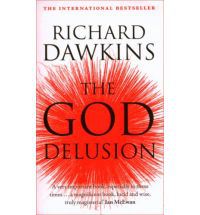
How deluded can a New Atheist be? Immediately preceding that shockingly renegade suggestion that insulting people is not good for serious dialogue was a paragraph about the impact of Richard Dawkins’ The God Delusion. The response of Jerry Coyne’s followers was to play the cute self-justifying word-game that insists a belief can be delusional without implying the believers themselves are delusional. So Coyne’s followers echoed his sentiments, disapproving of the Time article where it criticized NA approaches and magnifying beyond recognition of the original article where it made positive comments.
C Posted September 16, 2016 at 3:02 pm
Of course it is rather weird of the authors to write that bit (“calling religious people delusional … is not an effective cross-cultural strategy for generating change”) directly after saying this:
“The Arabic translation of Richard Dawkins’ The God Delusion, for example, has been downloaded ten million times, and pictures of people holding it while overlooking Mecca are remarkably commonplace given the draconian penalties for doing so—ranging from ten years imprisonment to death.”
and
HH Posted September 16, 2016 at 3:30 pm
I feel like that part of the article should have been left out completely as it makes the whole thing pointless. If NAs are the only ones who have made genuine in-roads because they’ve pointed out the falsity of religious beliefs, who exactly is going to take up the baton if they can’t take it any further?
It seems to be a bit of an apology to the religious for criticizing their (delusional) beliefs after they’ve just acknowledged that N. atheists are the only ones who’ve really got anywhere.
Is it really credible that NAs have had such “genuine in-roads” into the Arab Muslim world or that they have been “the only ones who’ve really got anywhere”? The Time article itself is more modest in its claims:
New Atheism may have inched into the Islamic world, but it has not found deep roots. . . .
The fact is that several publications have appeared since 9/11 about atheism and apostasy in the Islamic world that demonstrate how long-standing such conflicts have existed there, long before September 2001. That Richard Dawkins’ book was downloaded so often in those quarters testifies to the ready-demand existing there prior to its publication. Recall the Arab Spring when Muslims took to the streets often at risk to their lives to call for secular democratic governance. NAs surely evince a little hubris if they believe they are the ones who, as the “best (most rational) of their breed” have taken up Kipling’s “white man’s burden” and been responsible for exposing supposedly Islam-benighted souls to the pure light of reason.
Did you know that the world is round?
The Time article calls for more moderate and understanding strategies to open “candid dialogue about deep-rooted conflicts between reason and faith.” I can’t complain about new strategies but I do question the emphasis on demonstrating religion’s incompatibility with science.
Today I learned through a new Jerry Coyne post that The Baffler has posted a beautifully written article by Sam Kriss, Village Atheists, Village Idiots, making the same point in a much more interesting way. He compares the distinguishing NA strategy with the decision of a lunatic to repeat over and over “The world is round” to prove his sanity. No-one can disagree with that statement, he reasons, but of course he only manages to demonstrate that he fails to appreciate the contexts in which he is attempting to make his point, gets into bigger trouble, then protests that he is being persecuted for proclaiming nothing but the obvious truth!
Jerry Coyne, unfortunately, cannot grasp the point (to do so would require some uncharacteristic self-reflection) and in his typically open-minded style chooses to cut out the entire journal from his life for this one article: Idiot compares atheists to village idiots.
Everyone knows that religion and science embody irreconcilable understandings of the world. We don’t say insects are wrong because they are not plants. Or rabbit is stupid because it’s not a tree. Probably every child being reared by a family who believes God created everything (whether thousands of years ago or billions of years ago, whether by suddenly making fully formed species appear or by guiding evolution) and that science is either not the whole story or is the completely wrong story. No one needs to tell Religion that it does not agree with Science.
When anti-theists complain about the unscientific nature of religion they are really advertising their ignorance of what religion is, why it is, how it seems to have come about. New Atheists need to do their homework instead of merely shooting fish in a barrel for fun.
So when Peter Boghossian, James Lindsay and Phil Torres call on NAs to recognize the humanity in religion it sounds to me as though they are on the right track that leads eventually to a genuine understanding of what they are dealing with.
Understanding reality and how humanity works
Stubbornly oblivious to their dishonest claims about their past lives our three authors appeal to NA favourites Ayaan Hirsi Ali and Maajid Nawaz as guides to follow. Their flaws might be many, but NAs can nonetheless cherry-pick their writings to compile several worthy principles to follow. One of these:
Atheism, Ali points out, is a logical step that comes after Enlightenment values like rationalism and tolerance, and the liberties of a free, open and secular society are in place.
But to act on this most logical of precepts would mean actively protesting against our own Western governments who are propping up the regimes that violently crushed the Arab uprisings across North Africa and the Middle East not very long ago. Or in Syria it would mean calling on our leaders to withdraw all support for the Islamist thugs trying to replace the Assad regime and then throwing every effort into supporting the original Arab Spring leadership. Somehow I cannot see such genuine support for the building of “free, open and secular societies” coming from people like Sam Harris and Jerry Coyne. That’s a narrative that does not sit well with their view of Islam itself is the unregenerate evil to be confronted. Real people who actually make their religion (insofar as each of them has a religion) what it is are reduced to a mere shadow of the Beast of Islam itself.
I suspect the influence of “ex-Muslims” or “atheist-Muslims” of questionable character and tactics is at best limited in the Muslim world more generally. Changes are most likely to come from within the Muslim communities themselves. Muslims in countries like the US and Australia have in the main adapted to Western ways. Problems that persist are generally among the new generations, the “in-betweens” of the second generation feeling neither part of their traditional heritage nor at one with their parents’ new home. But that’s how it has always been with migrant families including the Greeks, the Italians, and then more recently the Vietnamese. We know that such conflicted worlds do eventually pass.
In an interview as well as in a book co-authored with Sam Harris Maajid Nawaz said something about Islam that I have seen few NAs notice: Islam is neither a religion of war nor a religion of peace. It is whatever people make it. That statement demolishes Islamophobic claims by many NA supporters that Islam is a force or power that is “by nature” evil. Naturally we all want to see the day when there will be no more human rights violations in the name of religion, but at the same time we need to understand what we are engaging with. Religious practices, however much they stand in opposition to human rights (and Christianity is still trying to move beyond its primitive days, too, let’s not forget) are not the same as terrorist ideologies. It is a mistake — and contrary to all serious research into the nature of radicalization and violent Islamists — to treat the two as if they are all part of the one package that contains a monolithic force for evil. As classic cultural imperialists NAs decide for themselves how to interpret the Qur’an and accordingly believe in the reality of their imaginary dragon spitting out terrorist flames at random. A more productive approach is to “recognize the humanity in religion” and listen to what all those living in the Muslim world (everyone from sceptics and rationalists to conservative, Western, Eastern and reformist imams) and those ideologically committed to the Islamist world are themselves saying.
What an enjoyable read! I have caught up with Luciano Gonzalez’s latest response in our little exchange and found myself appreciating overall where he is coming from as an atheist and with his earlier comments. I am sure our different perspectives are primarily the product of our different cultures. I cannot say I would not embrace the same approach as Luciano were I living in a Latin American and/or Bible Belt culture. No doubt being an atheist in Australia is a strikingly different experience.
We may have different views relating to the psychology that is related to religious beliefs and ways of living, but that is a minor issue in the context of this exchange of views.
I confess I had assumed from the outset that Luciano was a “card-carrying” Atheist+’er because of his Freethought Blog (FtB) platform, but he has said he is not. So there we go. Never judge a post by its blogging platform. I also admit my interpretation of Luciano’s original post was coloured by recent exchanges I had here over my “no extras atheism” post as well as the flurry over developments in the FtB circle having to do with Richard Carrier. I loathe the way the knives come out publicly, the slander and character attacks, and especially the self-righteous justifications for the same. I am referring to both sides of that sort of issue, and to its history – the Carrier episode is not the first. (There are other more respectable ways to administer discipline in a group. The Atheist+ MO looks to me to be even worse than some of the ways the religious cults handle their wayward members.)
Anyway, this is just to say Hi again to Luciano, and to say I’m glad I’ve made your acquaintance. I strongly appreciate your perspective now that I understand more fully where you are coming from. I wish you a happy and fulfilling adventure as an atheist in your thickly religious environment.
Luciano has written a new post — Vridar Response — responding to my response — What I want as an atheist a human — to his post — What I want as an atheist. (Should I explain that with a diagram?) It’s been a very busy day and I haven’t had a chance to read Luciano’s response yet, apart from his opening paragraph:
I enjoy being a morning bird. My writing isn’t extremely well-known, but I get the occasional response and sometimes I manage to be awake as they are published. Today is one such day. My post about what I as an atheist, “wanted” was seen by Neil Godfrey of Vridar, and got a response from him. I really liked his response but there are certain things that I think deserve a response. The ending is directly addressed towards Neil, but as usual I welcome any comments and or thoughts on the post and hopefully on a greater discussion about skepticism and atheism. I want to respond to individual bits and pieces before responding to the overall post (the last few paragraphs are where I respond to the overall post). So with that little bit of context, let’s get started!
I look forward to reading what he has to say, but till I get that chance some readers here might like to check out his comments and comment there, here, before I do.
This post follows on from (a) the discussion that took place in the wake of my Atheism without the extras, please post and (b) as a direct response to another Atheist+ (Freethought Blog) post that has recently been published by Luciano Gonzalez: What I Want As an Atheist. I really hope before reading the following you read Luciano’s post (I have modeled my own post on his paragraph points) or even the earlier discussion on this blog. So here’s saying Hello to Luciano — thanks for your post, and I hope you can appreciate my response even if you don’t agree with it.
–o0o–
As an atheist who takes his atheism, like his right-handedness, for granted, I rarely get involved in discussions about my beliefs. If one were to ask me “What do you want as an atheist?” I would agree with Luciano that it is a silly question and probably reply, “to be free not to believe in any gods.”
I used to be something of an anti-theist. That was in my first flush of leaving my coffin of religion behind and when I was still struggling to come to terms with what had happened to me (and the pain I had caused others) in all those fantasy years. Religion was a baleful influence in the world and its purveyors needed to challenged or excluded from activities that they were using to promote their ‘good works’ propaganda to the public.
I lost that angry antagonism after I came to terms with myself and my own experience with my past destructive cult experience. A huge help in that direction (among a number of sources of assistance) was psychologist Marlene Winell’s book, Leaving the Fold. I not only came to understand why I had got mixed up with the outfit in the first place, but most importantly, I learned to forgive and accept myself. And from that position I found myself forgiving and accepting others, too. I understood where other religious people were coming from and even felt for their situations.
I was not interested in supporting groups dedicated to attacking religious cults. Such attacks only fueled the persecution syndrome of the cultists themselves. The harm done within cults is enough to prise out defections. What is important is that such members who begin to question their beliefs have support, and that’s what I was very keen to offer. (I have described some of my activities at this time several times before: for those not familiar with the story, it involves newspaper advertising, community group meetings, etc. – and eventually even this blog.)
Following completes my notes on the Glenn Greenwald-Kyle Kulinski discussion that was a response to the above points raised by Kyle. Indented paragraphs are direct transcripts; the remainder is generally paraphrase.
I’ve copied the video link again at the end of this post.
The minutes/seconds markers are approximate.
6:00 —
Glenn G refers to the New Atheist’s toxic way of talking about the world. Harris is not just saying Islam is bad but that it is “the worst of all”.
No such thing as an “atheist agenda”?
7:00 —
GG: New Atheists may say that as atheists they have “no beliefs” as such and therefore plead that they have no “atheist agenda” but someone like Sam Harris clearly does have an identifiable and well-thought out agenda on a whole range of topics, including political ones.
Very serious radical fundamental differences in world views
8:30 —
GG:
There is this quote from Sam Harris that to me illustrates the crux of the disagreement. He said, Look, liberals think Dick Cheney is a really bad person who did a lot of really bad things, and that’s fine, you can think that. But what liberals need to understand in order for them to be rational is that there are tens of millions of Muslims in the world who are “far scarier than Dick Cheney”. — That world view is very familiar and very common. It is essentially saying, Yes, the United States maybe does some bad things in the world, but they don’t really rise to the level of evil; if you want to know true evil look to the adversaries of the United States — which is not just al Qaeda, which is not just ISIS, but “tens of millions” of human beings who identify as Muslims.
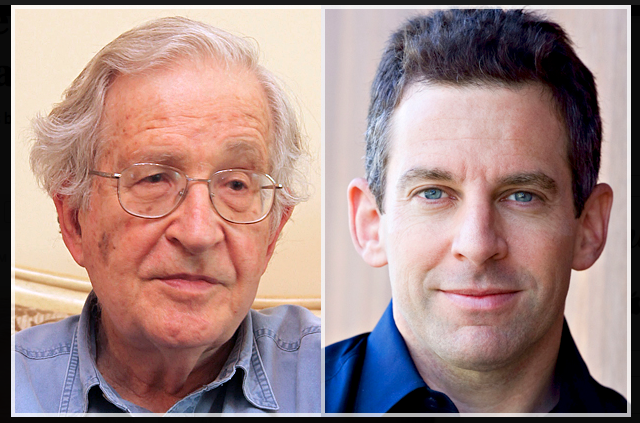
And in the recent exchange Sam Harris had with Noam Chomsky he identified the United States as what he called a “well-intentioned giant” [9:30]. And he said very much the same thing about Israel before. — (saying in effect:) Yes the United States and Israel might do some bad things but we’re morally superior to the adversaries of the United States and Israel.
So when I look at Sam Harris what I see is a person who is an American, who is a Westerner, who is a self-identified Jew, who runs around making the argument that the United States and Israel are morally superior to its adversaries. And to me this is kind of pure primitive tribalism. It’s the nub of what has driven the “war on terror” the last fifteen years. — the idea that sure, we do some bad acts but we do it by accident, we do it because we’re really well intentioned, but the true evil “is them”.
I think the reason it’s gotten so much negative attention is because unlike, say, Bill Crystal or Dick Cheney or actual hardcore neocons who you can look at and know exactly what they are and what they think — The way that this particular set of beliefs is lending support to this agenda is much more subtle and insidious and kind of disguised. — And I think therefore it is more pernicious, it is more deserving of attention.
Whatever else is true I think there are very serious radical fundamental differences in world views that this debate has largely been about.
The Kyle Kulinski-Glenn Greenwald exchange arose as a response to Kyle’s earlier video calling for a “cease fire” between New Atheists and other atheists. This post backtracks and looks at that video before resuming the Glenn Greenwald exchange.
During the exchange we were advised to view Kyle’s earlier video, New Atheists Vs Progressives — Proposing A Ceasefire, the one that Glenn Greenwald was responding to specifically. So I dutifully paused to check it out and was glad I did.
I’ll start with Kyle’s proposals in that video before presenting another paraphrase/transcript of Glenn G’s subsequent remarks and commentary.
Kyle wishes that both sides, New Atheists and others he calls Progressives, would
His argument sounds mathematically reasonable. If we agree with someone on a dozen key points that are very important to both of us and disagree on only one other one, then surely we should not be pouring scorn upon each other as if the other is beyond the pale.
Glenn Greenwald’s response demolished that point’s mathematical certainty, however. If I agree with Picklzanjam on feminist issues, gay rights, religion-is-bad, beer-is-good, etc etc etc etc — but after ticking all those check boxes Picklzanjam says he is also a white supremacist racist, then I’m not going to treat him as a good buddy I can get along with just because we agree on all of the other issues.
Kyle appeared to understand this point but later he wanted to push home his belief that people like Sam Harris are not really extremist in any of their views. I will return to that objection later when I cite Glenn G’s views on that view.
Second, Kyle wishes critics of the New Atheists would….
Here’s where I part company, to some extent, with a number of other atheists who are more activist in their critical stance against religion. Firstly I need to say I wish people did not feel a need for religion. Second, on a personal level I think religion sucks for a whole range of reasons. Third, I particularly deplore fundamentalist type cults and organizations for the particular harms that they can do — people literally die because of their teachings and practices, and some suffer the pain of a living death as a result of other practices and teachings. Continue reading “Why the War between New Atheists and Other (“Progressive”) Atheists?”
This is a “watch this space” post — PZ Myers has posted his own paraphrase of some points on the following discussion on his blog and I expect to be make my own notes to place here on Vridar asap.
The line that caught my eye was “New Atheists are engaging in rank tribalism. See Ashley Miller.” (I recently posted a reference to Ashley’s post here, as some readers will know.)
Libby Anne had a somewhat similar religious background to mine and has consequently acquired, like me, an enhanced ability to notice wherever cultish or tribal or fundamentalist types of behaviours and attitudes surface in other (supposedly religion-free) areas of society. Back in March this year and in the wake of the Craig Hicks’ murders of three Muslims she wrote You Can Count Me out of Atheist Tribalism. She writes:
There are a lot of differences between the Chapel Hill killings and the Charlie Hebdo killings, but both demonstrate what hatred and demonization of “the other” can lead to. I would think we should all be able to admit this and condemn it—right? Wrong. I’m absolutely flummoxed by Sam Harris’s insistence that crimes committed by atheists by definition have nothing to do with their beliefs.
I have bolded a section below because it so perfectly mirrors my own experience:
To put it simply, atheists who are quick to blame terrorism committed by Muslim individuals on Islam and just as quick to excuse atheism from any role in atrocities committed by atheists are using a glaring double standard.
Unfortunately, I have a lot of personal experience with these sorts of double standards. I grew up in an atmosphere where Christian atrocities were dismissed through ample use of the No True Scotsman fallacy. In fact, I believed that by definition, a Christian would not commit atrocities, and that if someone claiming to be Christian did so, they must not be truly Christian. It was a very handy way to excerpt my in-group from criticism while eagerly lobbing criticism at everyone outside of it.
I, for one, am not eager to repeat that.
And she concludes — with the same reason I have come to distance myself in recent years from some sort of fan-following of any New Atheist popularizer:
I didn’t leave one tribe, with its demonization of other groups and tribes, ample use of the No True Scotsman fallacy, and insistence on valuing in-group loyalty above all else, to join another tribe doing the exact same thing.
From arthwollipot, flickr: http://www.flickr.com/photos/arthwollipot/6796189874/sizes/m/in/photostream/
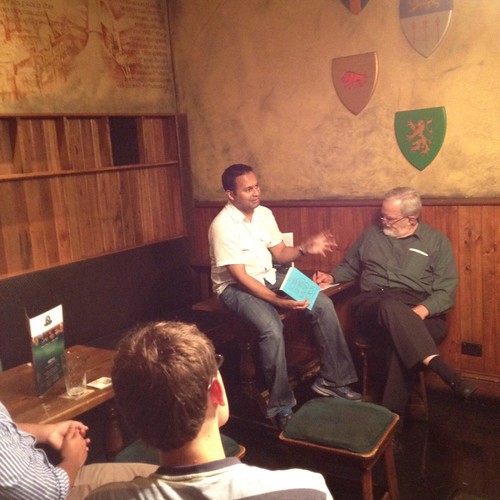
If you are atheist, a bit worried about Muslims at the same time, like ideas like love and compassion as the glue that holds us together, might respect reading recommendations from A. C. Grayling, are curious about where and why Australians have a different take (at least from North Americans and the British) on atheism and religion in the world — how to be laid back about it all — and basically what atheism means to all of us of whatever religious background and in particular how ex-Muslims handle it all, then do yourself a well-deserved favour and listen to the interview with Alom Shaha on Australia’s national radio program Big Ideas:
Atheist Alom Shaha: Imagine you live in a strict Muslim community. You’re taught not to question your religion. But you don’t actually believe any of it. Your interest lay in the world of science, ideas, and books. This is the world of atheist, Alom Shaha – a Bangladesh born science writer, film maker and teacher, who’s lived in London since he was young boy – who is in conversation with Paul Barclay.