
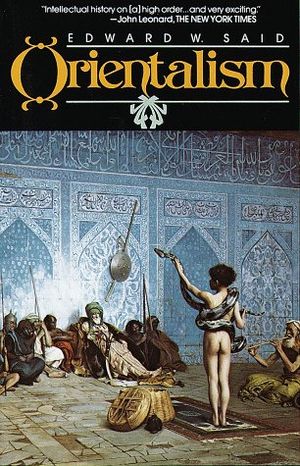
 One of the most influential publications of the twentieth century was Orientalism [link is to the Wikipedia article on the book] by Palestinian born American scholar Edward Said. The book has been translated into 36 languages and said to have revolutionized Middle Eastern studies in the U.S. Naturally, as with any major revolutionary work that challenges conventional ways of thinking, it has had its critics. I single out here some of Said’s commentary on Western attitudes towards Islam that I believe stand as valid today as they were when first published in 1978 and expanded in 1994. My own comments are in blue italics.
The principle dogmas of Orientalism:
- The absolute and systematic difference between the West, which is rational, developed, humane, superior, and the Orient, which is aberrant, underdeveloped, inferior.
- Abstractions about the Orient, particularly those based on texts representing a “classical” Oriental civilization, are always preferable to direct evidence drawn from modern Oriental realities.
- The Orient is eternal, uniform, and incapable of defining itself, therefore it is assumed that a highly generalized and systematic vocabulary for describing the Orient from a Western standpoint is inevitable and even scientifically “objective.”
- The Orient is at bottom something either to be feared (the Yellow Peril, the Mongol hordes, the brown dominion) or to be controlled (by pacification, research and development, outright occupation whenever possible).
Every one of those dogmas has come through loud and clear in the the writings of Sam Harris, Jerry Coyne and others, as well, of course, in many recent comments on this blog. We do not have to get to know or learn about Muslims from their own writings or history; we only need to pick up the Koran to see our suspicions and fears confirmed.
Islamic Orientalism accordingly believes there are still things such as “an Islamic society, an Arab mind, an Oriental psyche.”
It makes no difference whether we are talking about a situation in Bangladesh or events in Egypt, Palestine, Afghanistan or Bedford. The world is facing a threat from a singular religious belief system that threatens Western civilization.
Every facet of societies in the modern Islamic world is anachronistically interpreted through texts like the Koran. Continue reading “Orientalism, Us, and Islam”