Probably most readers here long before now have seen the video below (Piers Morgan interviewing Egyptian satirist Bassem Youssef on the current Israeli response in Gaza to the Hasbut I love it so much I want to display it here, too.
I confess to being a little taken aback by Ben Shapiro’s justification of the mass bombing of civilians (Dresden, Tokyo, Nagasaki …) by the Allies. I had long thought (after talking with some from that generation, including one who belonged to a bomber crew over Dresden) that “we” looked back on that kind of vengeful barbarism with some guilt and shame. Certainly not some kind of “tragic necessity”. Still naive after all these years.
I came across the 1971 debate between Michel Foucault and Noam Chomsky on human nature a couple of days ago; I last viewed it quite some years ago but found myself still fascinated enough to listen to it carefully through to the end once more. (There’s also a transcript online, I afterwards discovered.) And what memories — all that student long-hair!
What surprised me was that Foucault had lost none of his ability to leave me in some dismay with his insistence that a concept like justice is a social construct and instrument of class oppression.
I’ve been trying to get some little idea into the nature and origins of human ethics from the perspective of evolution and have come to see what we call ethical systems as phenomena found also in other social animals. No doubt Foucault would have said that what we observe in the animal kingdom generally is nothing more than displays of power struggles.
My own limited reading has suggested to me that a fundamental factor underlying ethical systems is the biological principle of reciprocity. Some readers no doubt have read more and can enlighten me further. Is not all ethics fundamentally about the well-being of living organisms so they can survive, flourish and reproduce? I will live at peace with you and not infringe upon your space as long as you respect my piece of territory that I need for my survival. From there we move to those experiments showing us monkeys throwing tantrums if they are not given the same rewards as their peers without any apparent justification for the inequity. Monkeys don’t talk about fairness or justice but they seem instinctively to understand the “fact” of what we describe with those labels.
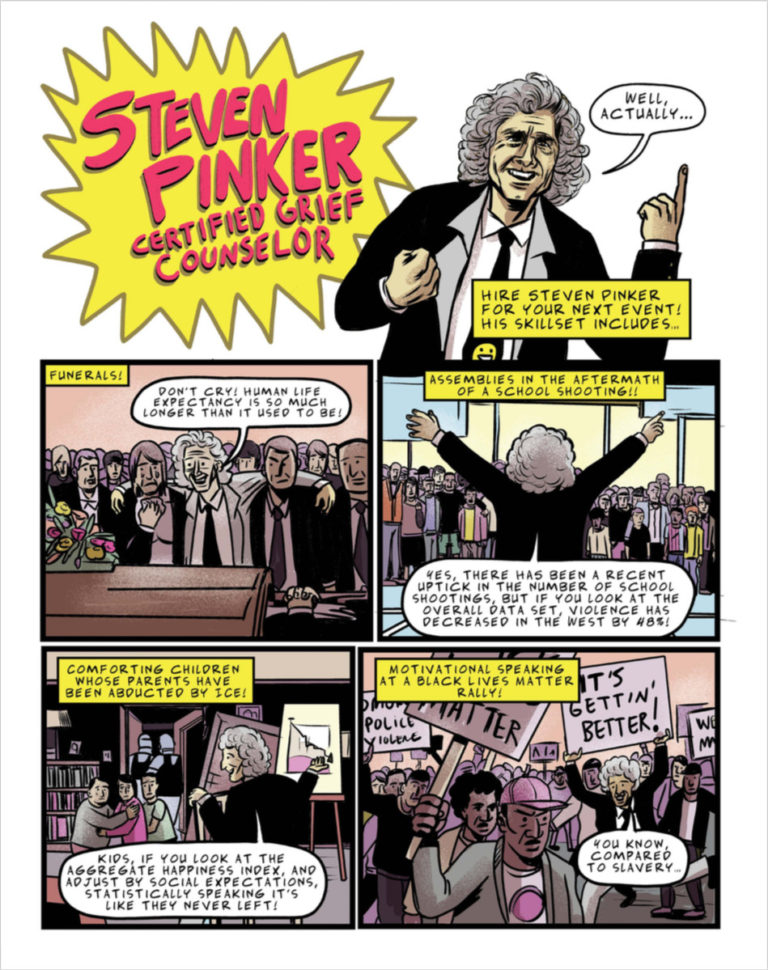
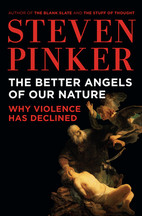
By the time I had completed the seventh chapter of Better Angels I began to feel my existence was somehow in a surreal place. Compared with most lives throughout human history mine has been fantastically lucky and overwhelmingly privileged. The pain that follows reminders and expanded awareness of just how cruel so much of human existence has been inevitably leaves some sense of guilt and a need to to do more to justify or repay the privilege of my life to date.
Pinker helps readers appreciate just how fortunate we are to be living in the ongoing momentum of the Enlightenment where the seeds of our humanistic and scientific values were planted. (Those who argue that the Enlightenment gave birth to Hitler and the Holocaust and other modern degradations are flat ignorant — Pinker describes the charges as “ludicrous, if not obscene” — since such movements were in fact a reaction against Enlightenment values.) Our moral and rights revolutions, the growth of “liberal” values, humanistic concerns and reactions against cruelty to slaves, children, other races and classes, democratic movements, human rights of liberty and equality, workers’ rights, children’s rights, civil rights, women’s rights, gay rights, animal rights, care for the environment — it’s been an incredible moment of history.
All of this has been accompanied by scientific and technological understanding, burgeoning education and even advances in our collective ability to reason and understand — all without the would-be diversions and false-leads of dogma and religion.
Pinker does not mention it, but what we witnessed early this century when millions of people came out into the streets all around the world to protest against the threat of an imminent invasion of Iraq was surely a most significant milestone in human history. Today there is even international outrage over the single killing of a lion for sport. We do live in the most amazing times. Continue reading “Better Angels of Our Nature”
Noam Chomsky’s recent piece in the Belfast Telegraph contained a fragment of a quotation from Walter Lippmann. It’s useful, because it helps to show how the ruling elites actually view the public: namely, not as a group of participants with legitimate concerns and ideas to offer, but rather as so much cattle that need to be prodded into going along with their betters.
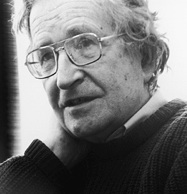
English: Photograph of Noam Chomsky (Photo credit: Wikipedia)
Noting that public opinion and government action are today often at odds with each another, Chomsky explains that for the power elites in our so-called capitalist democracies public opinion is something to affect, something to change via public relations, not something to follow. The governments of modern Western nation-states see the public as “meddlesome outsiders.” This term echoes Lippmann in The Phantom Public:
With the substance of the problem it [the public] can do nothing usually but meddle ignorantly or tyrannically. It has no need to meddle with it. Men in their active relation to affairs have to deal with the substance, but in that indirect relationship when they can act only through uttering praise or blame, making black crosses on white paper, they have done enough, they have done all they can do if they help to make it possible for the reason of other men to assert itself.
For when public opinion attempts to govern directly it is either a failure or a tyranny. It is not able to master the problem intellectually, nor to deal with it except by wholesale impact. (p. 60, The Phantom Public, emphasis mine)
For Lippmann and indeed for today’s policy makers, following the will of the public is a folly that would end in “failure or tyranny.” And so:
The public must be put in its place, so that it may exercise its own powers, but no less and perhaps even more, so that each of us may live free of the trampling and the roar of a bewildered herd. (p. 145, The Phantom Public, emphasis mine)
Our spectator democracies
That herd, Chomsky tells us, needs to understand its proper function.
They’re supposed to lend their weight every few years, to a choice among the responsible men. But apart from that, their function is to be “spectators, not participants in action” – and it’s for their own good. Because as the founder of liberal political science pointed out, we should not succumb to “democratic dogmatisms about people being the best judges of their own interest”. They’re not. We’re [viz., the ruling elite] the best judges, so it would be irresponsible to let them make choices just as it would be irresponsible to let a three-year-old run into the street. Attitudes and opinions therefore have to be controlled for the benefit of those you are controlling. It’s necessary to “regiment their minds”. It’s necessary also to discipline the institutions responsible for the “indoctrination of the young.” All quotes, incidentally. (emphasis mine)
For any libertarians or conservatives out there, please note that Chomsky has plenty of scathing words to say about the ineffectual parties on the left who, when in power, act exactly the same as conservatives. Public opinion is very much against austerity in Europe, but those destructive policies continue no matter which party is in power.
. . . economic policies have changed little in response to one electoral defeat after another. The left has replaced the right; the right has ousted the left.
Why does nothing change? Because the smarter class, the intelligent minority, knows better than to follow public opinion. “No man can serve two masters,” and we know who the real master is. As John Jay put it:
. . . the mass of men are neither wise nor good—those who own the country ought to govern it.
Wanted: fans not friends, spectators not participants
As it is with politics, so it is with academia, especially in that extremely rarefied realm of Biblical Studies. If you didn’t catch the undertone in the blog posts Neil quoted from in his recent post on kicking Atwill to the curb, let me remind you. Atwill’s theories on Christian origins are pretty far out there. In fact, they’re so far out there that they’re rather easy to debunk on their own merits. Yet that wasn’t enough, was it? We had to be reminded that he didn’t have the proper credentials.
In my first two years of college, I wandered from major to major — theatre, undecided, political science. One muggy day in the summer of 1979, I realized I was going nowhere. I was working in Columbus, Ohio, for a guy whose business model had something to do with selling frozen meat door to door. My meals consisted mainly of bread, peanut butter, and orange soda (or “pop”).
I was flat broke, with no options. So I decided to join the U.S. Air Force, following in my dad’s footsteps. To make a long story short, my language aptitude scores landed me in Russian language school at Monterey, then on to an overseas assignment. The job was interesting, and living in Berlin was a great experience, but I knew from the outset I was going to stay in only for the minimum four-year stint, and then head back to school.
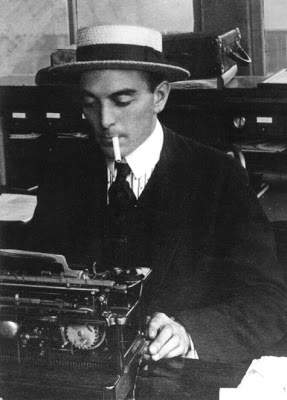
Ring Lardner
This time I knew exactly which I degree I wanted to pursue: a bachelor of arts in journalism. At the University of Maryland, I bided my time, waiting for seats in the first upper-level journalism class to open up. In the intervening period, I took lots of history courses as electives.
At last, I found myself on the first day of my first journalism class. The professor greeted us all and then asked us to go around the room, give a short introduction, and say which kind of journalism we were focused on. Everybody except me and one other guy said, “Radio and Television.” We, the two dinosaurs, had indicated we were interested only in print journalism.
At that very moment, I knew I couldn’t stay. Journalism was now a job for the shallow, pretty people. The beat reporter stabbing away at his typewriter with his index fingers trying to meet a deadline was a figment of my imagination, the ghost of a bygone era.
The power of self-selection
I selected myself out of my chosen field of study. I dropped my classes, switched to history, and never looked back. Since that time, mainstream journalism has gotten much, much worse. Had I stayed, I alone couldn’t have changed anything. But together, the large numbers of people who took themselves out of the mix — who decided not to stick it out and try to stem the tide — might have. Or perhaps not.
The power of self-selection often goes unnoticed. It’s a kind of opportunity cost. What would have happened if such-and-such had not happened? Who gives up? What sorts of people remain? Do they represent a broad section of society, or have the pressures of the system ensured that only certain people who think “the right way” have a voice?
What was especially interesting this time — and different from other interviews — was the extent to which he opens up about his personal life from childhood on and how he came to be where he is today.
I copy here a few of the comments from the Late Night Live webpage with the audio links, and some other videocasts:
Chomsky’s speech on receiving the Sydney Peace Prize and other (more political) interviews at the Sydney Opera House are also linked.
It is easy for theologians and biblical scholars to wear prophet mantles and appear to be courageously attacking the sins of the established powers. There can be an easy smugness in identifying one’s position with “the conscience” of the guild, the church, the public or nation. “Speaking Truth to Power” loses some of its awe when one finds the Power in turn rewarding its “gainsayers” with various honours and security of status. The game was played out without embarrassment from either side in Australia when one of its most socially and environmentally regressive Prime Ministers, John Howard, recommended a prominent social justice advocate cleric, Peter Hollingworth, to the Governor-Generalship, and awarded a leading environmentalist, Tim Flannery, Australian of the Year.
It is the responsibility of intellectuals to speak the truth and to expose lies. This, at least, may seem enough of a truism to pass over without comment. Not so, however. For the modern intellectual, it is not at all obvious.
Unfortunately, Crossley himself falls into the trap of joining other religion scholars who boast of critiquing imperialist, racial and class-warfare themes while in reality missing the heart and soul of Chomsky’s message. As a consequence Crossley becomes yet another brick in the wall of the establishment power he critiques only superficially.
Here is Crossley’s ironically correct explanation of the Chomsky model of how mainstream media works:
The propaganda model shows that the press is not really an important tool of democracy and it is not really disagreeable, argumentative or subversive of political power, at least not in any significant sense. The function of the mass media is to provide support for the special interests that dominate the state and private activity. This is reflected in their choices, emphases, and omissions. It is the powerful who fix the assumptions of media discourse and decide what is allowed to be seen and heard, often with the support of academics. Disagreements reflect disagreements among the elites. Although individuals may hold very different views from the agenda of mass media, these views will not be seriously reflected in the overall agenda or agendas. (pp.3-4, Jesus in an Age of Terror)
Yet this is exactly the place where Crossley’s own supposedly “independent” studies of Christian origins find themselves. He shares with his more religiously interested colleagues the logically flawed historiographical and epistemological assumptions that sustain that guild’s reason for existence.
Everyone knows — it is a simple truism — that one needs independent verification of any narrative before making assumptions about whether it is factual or not. This, at least, may seem enough of a truism to pass over without comment. Not so, however. For the [many a biblical scholar], it is not at all obvious.