
The most obvious objection to the previous post’s idea that the Torah was composed (or at least finally edited) in such a “cunningly ambiguous” manner as to allow divergent traditions and practices between and among Samaritans and Jews is the Samaritan tenth commandment. For Jews (or Judeans, the more appropriate term for the period we are addressing) the tenth commandment forbids coveting one’s neighbour’s house, wife, slave, ox or donkey. For the Samaritans, that is the ninth commandment. Their tenth is an order to construct an altar to Yahweh on Mount Gerizim. Since Judeans believed Jerusalem was ordained as the central place of worship we may think that a command to build an altar at Mount Gerizim could hardly have arisen through any collaborative effort of Samaritans and Judeans. But we would be wrong to think so.
But first, let’s be clear about what the Samaritan tenth commandment says. Here it is as it follows the command against coveting:
You shall not covet your neighbor’s house, you shall not covet his field, his male or female slave, his ox or his ass or anything that is your neighbor’s.
And when YHWH your God brings you to the land of the Canaanites which you are about to invade and occupy,
You shall set up large stones and coat them with plaster.
And you shall inscribe upon the stones all the words of this teaching.
And upon crossing the Jordan you shall set up these stones about which I charge you today, on Mount Gerizim.
And you shall build an altar there to YHWH your God, an altar of stones. Do not wield an iron tool over them.
You must build the altar of YHWH your God of unhewn stones. You shall offer on it burnt offerings to YHWH your God.
And you shall sacrifice well-being offerings and eat them there, and rejoice before YHWH your God.
That mountain is across the Jordan, beyond the west road which is in the land of the Canaanites who dwell in the Arabah, before Gilgal, by the terebinth of Moreh, before Shechem.
(Translation from Hepner 149; Hepner also points to an alternative Samaritan translation of the tenth commandment into English.)
There are several ways one can parse the words spoken from Mount Sinai to make them align with ten points. I have tried to capture the variants in this table along with some additional notes in the last row.
| Samaritan | Jewish | Protestant | Roman Catholic & Lutheran |
| 1 I am the Lord your God, who brought you out of the land of Egypt, out of the house of slavery. (Exodus 20:2)
(But see note below) |
1 I am the Lord your God, who brought you out of the land of Egypt, out of the house of slavery. . . . You shall have no other gods beside Me. . . You shall not make for yourself any graven image… |
||
| 1 You shall have no other gods before me.
You shall not make for yourself any graven image… |
2 You shall have no other gods beside Me. (Exodus 20:3)
You shall not make for yourself any graven image… (Exodus 20:4) |
1 You shall have no other gods before me. | |
| 2 You shall not make for yourself any graven image… | |||
| 2 You shall not take the name of the Lord your God in vain.
(But see note below) |
3 You shall not take the name of the Lord your God in vain. (Exodus 20:7) | 3 You shall not take the name of the Lord your God in vain. | 2 You shall not take the name of the Lord your God in vain. |
| 3 Remember the Sabbath day… | 4 Remember the Sabbath day… (Exodus 20:8) | 4 Remember the Sabbath day… | 3 Remember the Sabbath day… |
| 4 Honor your father and your mother. | 5 Honor your father and your mother. (Exodus 20:12) | 5 Honor your father and your mother. | 4 Honor your father and your mother. |
| 5 You shall not murder. | 6 You shall not murder. (Exodus 20:13) | 6 You shall not murder. | 5 You shall not murder. |
| 6 You shall not commit adultery. | 7 You shall not commit adultery. (Exodus 20:14) | 7 You shall not commit adultery. | 6 You shall not commit adultery. |
| 7 You shall not steal. | 8 You shall not steal. (Exodus 20:15) | 8 You shall not steal. | 7 You shall not steal. |
| 8 You shall not bear false witness | 9 You shall not bear false witness (Exodus 20:16) | 9 You shall not bear false witness | 8 You shall not bear false witness |
| 9 You shall not covet your neighbor’s house… You shall not covet your neighbor’s wife, nor his man-servant… |
10 You shall not covet your neighbor’s house…
You shall not covet your neighbor’s wife, nor his man-servant… (Exodus 20:17) |
10 You shall not covet your neighbor’s house…
You shall not covet your neighbor’s wife, nor his man-servant… |
9 You shall not covet your neighbor’s house… |
| 10 You shall not covet your neighbor’s wife, nor his man-servant… | |||
| 10 Build an altar on Mount Gerizim | |||
| Ex 20:2 – Preamble or first commandment:
The official Jewish view takes Ex. xx, 2-3 to be the First Commandment, followed by verses 4-6 as Second. But R. Ishmael (second century A.D.) counts verse 3 as the First Commandment, viewing verse 2, apparently, as a preamble, in complete agreement with Samaritan practice. A similar system is adopted by Josephus and Philo who count verse 3 as Commandment 1, verses 4-6 as Commandment 2 and verse 7 as Commandment 3. The Samaritans consider the first commandment of the Jewish tradition as an introduction to the Decalogue, so that in their tradition there is room for an additional commandment.
[T]he first three Commandments which are extant only on two of the stones (Nablus and Palestine Museum) are quoted with an interesting variation. The Nablus Decalogue has no trace of Ex. xx, 2 as part of the First Commandment, which verse is treated in the Samaritan MSS. as a preamble to the Decalogue. … The Palestine Museum inscription starts off with what is definitely taken from the official Jewish First Commandment (Ex. xx, 2). It has, after that, as its Second Commandment verse Ex. xx, 3 in exactly the same form as the Nablus stone, which latter treats this phrase as First Commandment. But the Jewish Third, ” thou shalt not take the name of Lord thy God in vain”, which is the Samaritan Second Commandment, is omitted in the [Palestinian inscription] while it is found in the [Nablus inscription]. This seems to suggest that [Palestinian inscription] included in its Second Commandment by implication Ex. xx, 7, the Jewish Third Commandment. |
|||
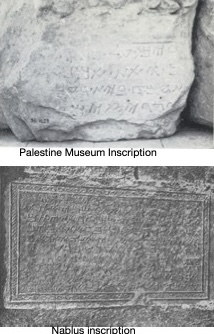
As we can see from the table there are several ways one can count “the ten”.
Furthermore, Judeans would interpret the Gerizim command as a one-time action to apply to the moment when Israel entered the land of Canaan and not as an ongoing command.
Bóid’s observation that we cited in the previous post applies:
We see, then, that there is nothing in the Samaritan Torah that is necessarily unacceptable to Jews, and nothing in the MT [=Masoretic Text of the Jewish Bible] that is necessarily unacceptable to Samaritans.
(Bóid 340)
But is not the Samaritan tenth commandment a “blatant interpolation”, an egregious sectarian intrusion into the narrative of the Ten Commandments? It does not have to be read that way. There is nothing in the tenth commandment that is not found elsewhere in the Jewish Torah. The editors have merely turned to Deuteronomy and copied verses from there into the Exodus account of the Ten Commandments. So there is nothing new or objectionable in the wording, even to Judeans who worshiped in Jerusalem. And what for the Samaritans could be read as a command to be kept “forever” for the Judeans could be read as a one-time historical edict.
I have constructed the following table from an article by Stefan Schorch (2019) to illustrate how the Samaritan tenth commandment was composed. It begins with the Samaritan ninth commandment and shows what passages from Deuteronomy were inserted at this point in Exodus 20 and the second narration of the ten commandments in Deuteronomy 5. The column on the right lists the verses of the Samaritan tenth commandment so you can see how they were taken from Deuteronomy 11 and 27 (middle column). You will notice that the passage from Deuteronomy 11:29-30 has been split to form an inclusio — a frame — for the main body of the commandment.
| Ex 20:17 Dt 5:21 |
You shall not covet your neighbour’s house. You shall not covet your neighbour’s wife . . . | |
| Dt 11:29 | When the LORD your God has brought you into the land you are entering to possess, you are to proclaim on Mount Gerizim the blessings, and on Mount Ebal the curses. | And when YHWH your God brings you to the land of the Canaanites which you are about to invade and occupy, |
| Dt 27:2 | When you have crossed the Jordan into the land the LORD your God is giving you, set up some large stones and coat them with plaster. | You shall set up large stones and coat them with plaster. |
| Dt 27:3 . . . . . . Dt 27:8 |
Write on them all the words of this law when you have crossed over to enter the land the LORD your God is giving you, a land flowing with milk and honey, just as the LORD, the God of your ancestors, promised you.
And you shall write very clearly all the words of this law on these stones you have set up. |
And you shall inscribe upon the stones all the words of this teaching. |
| Dt 27:4 | And when you have crossed the Jordan, set up these stones on Mount Ebal [original=Mount Gerizim — see note below], as I command you today, and coat them with plaster. | And upon crossing the Jordan you shall set up these stones about which I charge you today, on Mount Gerizim |
| Dt 27:5 | Build there an altar to the LORD your God, an altar of stones. Do not use any iron tool on them. | And you shall build an altar there to YHWH your God, an altar of stones. Do not wield an iron tool over them. |
| Dt 27:6 | Build the altar of the LORD your God with fieldstones and offer burnt offerings on it to the LORD your God. | You must build the altar of YHWH your God of unhewn stones. You shall offer on it burnt offerings to YHWH your God. |
| Dt 27:7 | Sacrifice fellowship offerings there, eating them and rejoicing in the presence of the LORD your God. | And you shall sacrifice well-being offerings and eat them there, and rejoice before YHWH your God. |
| Dt 11:30 | As you know, these mountains are across the Jordan, westward, toward the setting sun, near the great trees of Moreh, in the territory of those Canaanites living in the Arabah in the vicinity of Gilgal. | That mountain is across the Jordan, beyond the west road which is in the land of the Canaanites who dwell in the Arabah, before Gilgal, by the terebinth of Moreh, before Shechem. |
It is clear, therefore, that the Samaritan tenth commandment is nothing other than a rearrangement of passages from Deuteronomy. In the narrative flow of the Pentateuch, a Judean reader would have understood that an altar was to be built on Mount Gerizim but the same Judean reader would have understood those passages as a reference to a one-time historical moment – not as an eternal command.
Indeed, the above method of rearranging biblical material into new configurations was typical of the way scribes worked to produce expanded and “clearer” or more “relevant” texts, as can be seen in the “rewritten scriptures” of the Dead Sea Scrolls:
Scholars have long noted that the redactional process resulting in the new Samaritan Tenth Commandment shares many characteristics with the scribal tradition that produced the expanded Qumran scrolls. In fact, the techniques are identical. . . . The creation of the new tenth commandment, which takes material from Dtn 27 that had no connection to Sinai, exhibits the same type of freedom as in the third insertion in SP [=Samaritan Pentateuch] Ex 20, »showing that the ›Samaritan‹ scribe was only following his predecessor’s footsteps«. Moreover, the Samaritan Tenth Commandment did not involve the creation of any new material; the scribe simply duplicated text found elsewhere in the Pentateuch, including the reference to Gerizim, taken from Dtn 27,4 according to what many scholars now regard as the original text of that passage. As Tigay rightly comments: »What is noteworthy about the interpolator’s technique is that actual changes in substance are remarkably few. On the whole he accomplished his tendentious purpose with material already present somewhere in his sources.«
(Gallagher 104)
.
Mount Ebal or Mount Gerizim?
In case you think I am cheating by striking out Mount Ebal in the above table and replacing it with Mount Gerizim, I appeal to the scholars in my defence. (Recall also the same point made by Gallagher in the above quotation.)
We have to realize, however, that the Masoretic [=the Jewish Bible] reading in Deut 27:4 בהר עיבל “on Mount Ebal” is almost certainly a secondary ideological correction, as opposed to the text-historically original בהר גריזים “on Mount Gerizim”, which is preserved in the Samaritan Pentateuch and the Old Latin (Vetus Latina). According to the original text of the Book of Deuteronomy, therefore, this altar is to be built on Mount Gerizim, which is the mountain of the blessings according to the framing passages Deut 11:29 and 27:12‒13.
(Schorch 2011 28)
Magnar Karveit discusses the manuscript evidence through a six page excursus and concludes:
… that the reading “Gerizim” in Deut 27:4 is older than the reading “Ebal” of the [Masoretic Text = Jewish Text].
(Karveit 305 — the title of the excursus is Deuteronomy 27:4 in the Old Greek Papyrus Giessen 19 and in the Old Latin Lyon Manuscript, and the Altar-Pericope in Joshua 8:30–35)
In the following passage the sign ⅏ represents the Samaritan Pentateuch:
The main ideological change in ⅏ concerns the central place of worship. Wherever the Torah mentions or alludes to Jerusalem as the central place of worship, ⅏ inserted, sometimes by way of allusion, Mount Gerizim, . . . This change is particularly evident in the Samaritan tenth commandment referring to the sanctity of Mount Gerizim. This commandment consists of verses occurring elsewhere in the Torah: Deut 11:29a, Deut 27:2b-3a, Deut 27:4a, Deut 27:5-7, Deut 11:30, in that sequence in ⅏-Exodus and Deuteronomy. The addition includes the reading of ⅏-Deut 27:4 “Mount Gerizim” instead of “Mount Ebal,” which appears in most other witnesses, as the name of the place where the Israelites were commanded to erect an altar after the crossing of the Jordan.140
140 This reading is usually taken as tendentious, but since it is also found in the Vetus Latina+ it should probably be considered non-sectarian and possibly original. . . . A reading [Mount Gerizim] is also found in a Judean Desert fragment (Qumran cave 4?). –> U. Schattner-Rieser, “Garizim versus Ebal: Ein neues Qumranfragment Samaritanischer Tradition?” Early Christianity 2 (2010) 277-81. See also R. Pummer, “APΓAPIZIN: A Criterion for Samaritan Provenance?” JSJ 18 (1987) 18-25. This reading, written as one word, occurs also in a Masada fragment written in the early Hebrew script+ (papMas 1o). –> Talmon, Masada VI, 138-47. However, the Samaritan nature of that fragment is contested by H. Eshel, “The Prayer of Joseph, a Papyrus from Masada and the Samaritan Temple on APΓAPIZIN,” Zion 56 (1991) 12536 (Heb. with Eng. summ.).
(Tov 87f)

Who proclaimed the commandments? God or Moses?
One may object that in both the Samaritan and Jewish/Judean texts it is Moses who is instructing the Israelites to build the altar on Mount Gerizim so it could hardly be one of the “Ten Commandments” per se. Not so, however. It is only in the first of the ten commandments even in the non-Samaritan versions where God speaks in the first person. Returning to Schorch:
[O]nly the First of the Ten commandments (according to the traditional Samaritan counting), uses indeed the divine first person:
You shall have no other gods besides Me. . . .
Beginning with the Second commandment (Samaritan counting), God is referred to in the third person, where applicable:
You shall not swear falsely by the name of the LORD your God; for the LORD will not clear one who swears falsely by His name. etc. (Exod. 20:7)
The literary difference between these two parts is obvious and was already observed by early Jewish Midrashim preserved in Pesikta de-Rab Kahane and the Babylonian Talmud, which solved the problem by suggesting that only the beginning of the Decalogue reflects God’s own speech, while the reminder is attributed to Moses and refers to God in the third person. 34 From that perspective, the Gerizim composition, inevitably continuing the mode of speaking introduced already with the Second commandment (Exod 20:7), is more plausibly understood as being inserted in the context of Moses’ words rather than God’s
(Schorch 2019 93f)
So the fact that the narrative has Moses speaking the Mount Gerizim command to the Israelites does not disqualify it from being one of the “Ten Commandments” — if one’s tradition wanted it that way.
The Samaritans read this passage as the tenth commandment. The Jews can find nothing objectionable in the extended verse because all of those instructions are found elsewhere in the Pentateuch; the main difference is that the Jews count the earlier commandments differently so that the Jews would not need to read the extended passage of the Samaritans as one of the ten commandments. So it comes down to how one counts and how one interprets the temporal context of the command.
In the next post I hope to present some of the evidence that the Mount Gerizim command preceded both the traditional Samaritan Pentateuch and Jewish Bibles.
Bóid, Iain Ruairidh MacMhanainn. Principles of Samaritan Halachah. Leiden ; New York: Brill Academic Pub, 1989.
Bowman, J., and S. Talmon. “Samaritan Decalogue Inscriptions.” Bulletin of the John Rylands Library 33, no. 2 (March 1951): 211–36. https://doi.org/10.7227/BJRL.33.2.3.
Gallagher, Edmond L. “Is the Samaritan Pentateuch a Sectarian Text?” Zeitschrift Für Die Alttestamentliche Wissenschaft 127, no. 1 (January 20, 2015). https://doi.org/10.1515/zaw-2015-0007.
Hepner, Gershon. “The Samaritan Version of the Tenth Commandment.” Scandinavian Journal of the Old Testament 20, no. 1 (May 2006): 147–52. https://doi.org/10.1080/09018320600757101.
Kartveit, Magnar. The Origin of the Samaritans. Leiden: Brill, 2009.
Schorch, Stefan. “The Samaritan Version of Deuteronomy and the Origin of Deuteronomy.” In Samaria, Samarians, Samaritans: Studies on Bible, History and Linguistics, edited by József Zsengellér, 23–38. Walter de Gruyter, 2011.
Schorch, Stefan. “The So-Called Gerizim Commandment in the Samaritan Pentateuch.” In The Samaritan Pentateuch and the Dead Sea Scrolls: 94, edited by M. Langlois, 77–98. Leuven ; Bristol, CT: Peeters, 2019.
Tov, Emanuel. Textual Criticism of the Hebrew Bible. 3rd edition, revised and expanded. Minneapolis, Mn: Augsburg Books, 2011.


Neil Godfrey
Latest posts by Neil Godfrey (see all)
- What Others have Written About Galatians (and Christian Origins) – Rudolf Steck - 2024-07-24 09:24:46 GMT+0000
- What Others have Written About Galatians – Alfred Loisy - 2024-07-17 22:13:19 GMT+0000
- What Others have Written About Galatians – Pierson and Naber - 2024-07-09 05:08:40 GMT+0000
If you enjoyed this post, please consider donating to Vridar. Thanks!
Regarding date of composition, does it necessarily have to be the Samaritan commandments copying from Deuteronomy? What about vice versa? If the Deuteronomist was writing/compiling at a later, even Hellenistic date, doesn’t that suggest he drew from the prior Samaritan commandments?
There’s no reason to think that the Samaritans copying to make their distinctive Samaritan Pentateuch could not have happened in the Hellenistic era.
As for direction of copying, though, the simplest model is that some Samaritans copied from a simpler text to create their tenth commandment. If it were the other way around then we would have to postulate that Judeans removed the Mount Gerizim command from the list of Big Ten but still kept it elsewhere — which would not be much point if they were really trying to eliminate the Mount Gerizim command altogether.