2025-12-22

Looking for Evidence for a Persian Period Temple in Samaria’s Mount Gerizim – Part 3

Creative Commons License
This work is licensed under a Creative Commons Attribution 4.0 International License.

by Neil Godfrey

Continuing with Part 3….uraei tree.001 300x144

Surely a simpler explanation is that the capitals bearing those motifs [Astarte’s tree of life and guardian cobra heads] were on Mount Gerizim because they were not forbidden in Persian times.

This time I will skip the background introduction and begin with a list of English language articles by Yitzhak Magen. There are no doubt other articles that I have not noticed but I am more than willing to address anything of relevance if they come to my notice. Do the following writings add anything to Magen’s claim that he has published “unequivocal” proofs of a Samaritan Temple in Mount Gerizim in Persian times?

  • Magen, Yitzhak. “The Dating of the First Phase of the Samaritan Temple on Mount Gerizim in Light of the Archaeological Evidence.” In Judah and the Judeans in the Fourth Century B.C.E, edited by Oded Lipschits, Gary N. Knoppers, and Rainer Albertz. Eisenbrauns, 2007.
  • Naveh, Joseph, and Yitzhak Magen. “Aramaic and Hebrew Inscriptions of the Second-Century BCE at Mount Gerizim.” ’Atiqot 32 (1997): 9–17.
  • Stern, Ephraim, and Yitzhak Magen. “Archaeological Evidence for the First Stage of the Samaritan Temple on Mount Gerizim.” Israel Exploration Journal 52, no. 1 (2002): 49–57.

I’ll address them in chronological order.

Article 1

  • Naveh, Joseph, and Yitzhak Magen. “Aramaic and Hebrew Inscriptions of the Second-Century BCE at Mount Gerizim.” ’Atiqot 32 (1997): 9–17.

Magen begins by explaining a detail that partly contradicts something he wrote in a later work and that was discussed in Part 1 of this series. In this 1997 article, the massive wall with its three imposing gates, the same that reminded him of Ezekiel’s description of a gated wall surrounding the Jerusalem Temple, was not from the Persian period at all.

The area of the sacred precinct on the summit of the mountain is about 5 acres. Two building  stages have been identified: the ancient precinct, dating to the Persian period, and a later one, from  the Hellenistic period; the precinct occupied the  same area in both stages. The later precinct was  surrounded by a particularly thick wall, built, like the residential buildings, of dressed quarried  stones, and coated on the outside with three layers of plaster. . . . Three gates can  be dated to this stage: the southern gate, originally  used by worshippers as the main entrance gate, of which a tower and a broad staircase have survived;  and the northern and eastern gates, of which  several cells have survived, recalling the structure  of the gates in the book of Ezekiel (40:6-16) and  the Temple Scroll. (my bolding and italics in all quotations)[1]

Later Magen wrote that some of the Persian period gates also reminded him of Ezekiel’s description. Details to help the reader decide what was so Ezekiel-like in the Persian wall are not abundant in his later post.

Again, Magen makes his emphatic declaration of what “we know” about the date of this temple for which he has provided no evidence:

However, while Josephus dates the construction to the reign of Alexander the Great, we now know that it was built in the time of Nehemiah.[2]

The remainder of the article addresses the inscriptions on the stones within the area of the precinct. All that needs to be pointed out here is that all of these inscriptions are dated from the Hellenistic era and later.[3]

The unprecedented large number of inscriptions at one site indicates that the Samaritans habitually wrote inscriptions on building stones, from the Hellenistic period onward.[4]

So when one quotes Magen’s translations of the inscriptions that seem to suggest the existence of a temple connected in some way to the stones, one is doing nothing more than sharing evidence suggesting a temple in the Hellenistic period or later. We will return to the dating of the inscriptions in the last part of this post.

Article 2

  • Stern, Ephraim, and Yitzhak Magen. “Archaeological Evidence for the First Stage of the Samaritan Temple on Mount Gerizim.” Israel Exploration Journal 52, no. 1 (2002): 49–57.

Now here we have a most interesting article. Two capitals of Phoenician design, bearing Phoenician and Egyptian religious motifs, were discovered on Mount Gerizim by Yitzhak Magen’s team.capitals.001 300x203
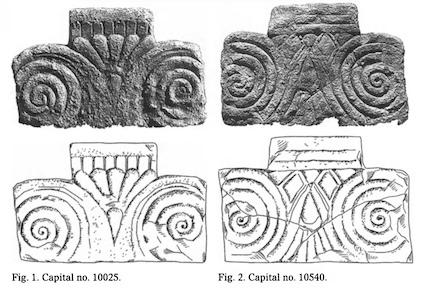
[5]

They consist of two motifs, “the central triangle with the two spiralling volutes and a Phoenician palmette”, very common among the Phoenicians and Iron Age Israel (that is before the Assyrian captivity).

[T]hey represent the Phoenician-Israelite version of the ‘tree of life’ (fig. 7), that major and most common ancient Near Eastern motif (Stern 1995: 319-334), towards which devotees turned with raised hands, standing or kneeling on both sides. This motif . . . was adopted from an Egyptian prototype, and is depicted . . . on a number of ivories found in the palace of the Israelite kings at Samaria . . . [6]

tree of life.001 300x258

[7]

The article continues:

It now seems almost certain that the ‘tree of life’ in these times symbolised the goddess ‘Astarte, the main Phoenician female deity. . . .

The other sacred emblem appearing on one of our capitals (fig. 1) is that of seven uraei [raised cobra heads], the heads of whom were cut away, . . . . In Egypt, uraei symbolised divine protection and as such they served as guardians to sacred locations . . . [8]

Stern and Magen conclude that the capitals were originally made in the time of the Israelite monarchy, perhaps for use in Shechem. So how to explain their presence on Mount Gerizim? Their answer: they were relics of the old “House of Yahweh” in Shechem but were taken from ruins there and re-used for the Temple on Mount Gerizim in Persian times.[9] This is their conclusion, even though they earlier wrote,

[B]oth capitals exhibit the motifs of the ‘tree of life’ and the uraei, which were prohibited during the Persian and Hellenistic periods by the Samaritan religious authorities, who—at this period—were strictly monotheistic. To the best of our knowledge, these two emblems are strict exceptions among the finds of the Mount Gerizim temple.[10]
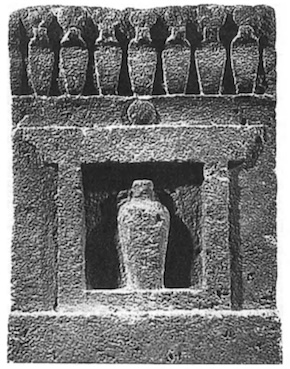
uraei.001 236x300[11]

Surely a simpler explanation is that the Persian period Samaritans continued the same form of Yahweh worship much as it had been practised in the days of the kingdom – and as it still appeared to be practised among Jews at Elephantine in Egypt, complete with a pantheon of gods alongside Yahweh. In other words, the capital with those “pagan” motifs was on Mount Gerizim because they were not forbidden in Persian times.

So I don’t see any evidence in this article for the kind of temple Magen would want us to imagine was constructed in Persian era Mount Gerizim.

Article 3

  • Magen, Yitzhak. “The Dating of the First Phase of the Samaritan Temple on Mount Gerizim in Light of the Archaeological Evidence.” In Judah and the Judeans in the Fourth Century B.C.E, edited by Oded Lipschits, Gary N. Knoppers, and Rainer Albertz. Eisenbrauns, 2007.

Once more Yitzhak Magen begins his discussion by claiming the two-stage construction on Mount Gerizim’s “sacred precinct” area: the Persian period of the mid-fifth century BCE and the Hellenistic period of the early second century BCE. Magen describes the layout of the “sacred precinct”, its measurements, and so forth. The western wall has no discernable gate and Magen believes this is because it was closest to a Temple’s “holy of holies”:

This lack of gates may be due to the location of the Holy of Holies, the extremely hallowed rear extremity of the temple. I believe that the current Samaritan sacred site known as “The Twelve Stones” is located in the area of the Holy of Holies.[12]

Unfortunately “belief” is not evidence. Magen continues:

The Persian-period enclosure most likely featured three chamber gates: to the north, the east, and the south, reminiscent of the temple gates depicted in the book of Ezekiel (40:10–16), which was the basis for the temple built by the returning Babylonian exiles. The temple built by the returnees served, in turn, as the model for the temple erected by the Samaritans on Mt. Gerizim.[13]

So gates that “most likely” were there are “reminiscent” of Ezekie’s gates, which was the blueprint for the Jerusalem Temple supposedly built by returnees from Babylon – even though we have even less evidence for such a temple in Jerusalem at this time nor any for waves of returnees from Babylonian captivity. (See Evidence Against Jerusalem in Persian Times Producing the Hebrew Bible)

The closest Magen comes to offering any semblance of a Persian period temple is the following:

The precinct yielded thousands of pottery vessels and burned bones of sacrifices—of sheep, goats, cattle, and doves. The coins from the Persian period, the pottery vessels, and Carbon 14 (C-14) testing at the site enable us to ascribe the first phase of the temple to the mid-fifth century b.c.e. This temple was active for approximately 250 years, until the establishment of the new temple in the Hellenistic period.[14]

And then,

Numerous discoveries from the sacred precinct substantiate the existence of a Temple to the Lord. Dozens of finely dressed ashlars of similar size and fashioned with stone masons’ marks had been removed from the temple’s walls and were unearthed in the excavations. These stones, the only ashlars discovered on Mt. Gerizim in either private or public construction, were quarried away from Mt. Gerizim before being brought to the site. The debris yielded proto-Ionic or Aeolic capitals belonging to the early temple from the Persian period (fig. 8). The inscriptions discovered on Mt. Gerizim are the most striking indication of the existence of a temple.[15]

Those inscriptions, as we have seen, are acknowledged by Magen elsewhere to belong to the Hellenistic and later periods, not the Persian period. And figure 8 is a repeat of the one we saw bearing the pagan motifs associated with Astarte’s Tree of Life and the Egyptian guardian cobra (uraei).
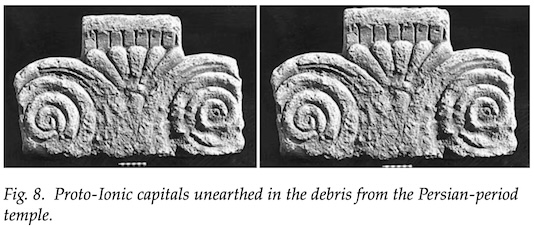
capitals1.001 300x128

[16]

Concerning the inscriptions, Magen explains their relevance for a temple:

The inscriptions discovered on Mt. Gerizim are the most striking indication of the existence of a temple. Some contain the titles of the priests who served as religious functionaries (fig. 9),4 while others contain the formulas “before the God in this place,” “before (the) God,” or “before the Lord,” which are always indicative of a temple (fig. 10).5 An additional inscription in Hebrew notes “that which Joseph offered for his wife and his sons before the Lord in the temple” (fig. 11).6 Yet another inscription mentions the “house of sacrifice,” an expression that parallels an expression used to refer to the temple in Jerusalem (2 Chr 7:12).7 An inscription in Paleo-Hebrew script contains the Tetragrammaton, apparently as part of the phrase “the house of the Lord” (fig. 12).8 A Greek inscription on a sundial contains the phrase “Highest God,” which is the name of the Lord in Greek. Perhaps the most fascinating discovery is a small gold bell with a silver clapper from the fringes of the high priest’s ephod (Exod 28:33–35; fig. 13). [17]

Each of the footnotes I have preserved in the above quotation (from 4 to 8) point to twenty translations of inscriptions found in the volume that we discussed under the heading JSP vol. 2 in Part 1 of this series. Recall that Magen had introduced all of those inscriptions with this observation of their post-Persian date:

The excavations of Mt. Gerizim brought to light some four hundred inscription fragments in Neo-Hebrew and Aramaic (lapidary and Proto-Jewish) scripts, inscribed on building and paving stones, that were found inside the city’s Hellenistic period sacred precinct. Scores of Greek inscriptions were uncovered as well, some from the Hellenistic period, but most dating from the  reconstruction of the Samaritan sanctuary in the reign of Constantine I in the fourth century CE; some also dated from the time of the subsequent Byzantine church. Also found were a few inscriptions in the Samaritan script, whose style dates them to the medieval period. The unprecedented large number of inscriptions at one site indicates that the Samaritans habitually wrote inscriptions on building stones, from the Hellenistic period onward. . . .

We believe that most of the early inscriptions should  be dated to the Hellenistic period (third-second centuries BCE), although some may belong to the  earliest period of the sacred precinct (fifth-fourth centuries BCE).[18]

No further discussion attempts to justify the “belief” that “some may” belong to the fifth-fourth centuries.

As for the “dating the first phase of the Temple and the surrounding precinct”, Magen refers readers to the finds already covered in this series:

This section is devoted to the Persian period, with the goal of ending the long-standing debate concerning the beginnings of the Samaritan temple at the site. I anticipate that the presentation of the ceramic finds, the coins, and the C-14 examinations of the bones and ashes of the sacrifices will securely date the construction of the first phase of the temple to the mid-fifth century B.C.E. and not to the late fourth century B.C.E.—the time of Alexander the Great—as was claimed by Josephus (and subsequently by later scholars). [19]

As we have already seen, Magen does well enough in convincing us of the date of the pottery but continues to fail to explain how this pottery is evidence of a nearby temple:

[A]ll the pottery discovered at the site’s sacred precinct is to be securely dated to the period between the fifth and the fourth centuries b.c.e., that is, before the conquest of Alexander the Great. This dating is further supported by the numismatic finds.[20]

Similarly, again as we have seen by now, with the coins:

Despite the abundance of coins at the site, the number of coins from the Persian period is relatively small. . . .

I conclude, therefore, that all the Samaritan coins found on Mt. Gerizim, even if undated, preceded the time of the conquest of Alexander the Great (figs. 27–29).[21]

Gerizim coins.001

And the date of the ashes of the sacrificed animals? As we would expect:

Several C-14 samples were taken of charred wood and bones found at the site, all from the strata belonging to the early phase of the sacred precinct—the Persian–Ptolemaic period (450–200 B.C.E.), preceding the Seleucid conquest of the land of Israel in the time of Antiochus III.[22]

And we recall Magen’s perhaps inadvertent reminder elsewhere that there were more common centres for regular sacrifices than temples:

The sole acceptable fashion of worshiping a deity, whether YHWH or some other god, was by the construction of altars, shrines, and temples and offering sacrifices and burning incense.[23]

Conclusion

I believe that I have given Yitzhak Magen a fair chance to demonstrate the existence of a temple on Mount Gerizim in Persian times. When I first saw his emphatic claims (e.g. “unequivocal proof”) I assumed that he must have published irrefutable material evidence for that temple. I remained puzzled, however, by a few remarks of other scholars holding on to doubts or even outright rejection of such a temple. And the only other scholars who insisted on the temple cited the same source: Y. Magen. So I read and re-read Magen’s volumes on the archaeological finds and have presented the main points in this series of posts. I fail to see how Magen has come close to demonstrating that a Samaritan temple was built on Mount Gerizim in the Persian period.

And without that evidence, we cannot assume that Deuteronomy or any other work reflecting temple ideologies of the Pentateuch was being composed.

The fact is that Magen has left indications in his writings that support the alternative view that Samaria in Persian times embraced a polytheistic cult worship of Yahweh. Evidence for Pentateuchal ideas does not surface until well into the Hellenistic period.


Notes

[1] Joseph Naveh and Yitzhak Magen, “Aramaic and Hebrew Inscriptions of the Second-Century BCE at Mount Gerizim,” ’Atiqot 32 (1997): 9. Bolded highlighting is mine.

[2] Naveh and Magen, “Aramaic and Hebrew Inscriptions of the Second-Century BCE at Mount Gerizim,” 10.

[3] Naveh and Magen, “Aramaic and Hebrew Inscriptions of the Second-Century BCE at Mount Gerizim,” 10ff. The same article covers inscriptions clearly made in the Christian era.

[4] Yitzhak Magen et al., Mount Gerizim Excavations. Volume I: The Aramaic, Hebrew and Samaritan Inscriptions, trans. Edward Levin and Michael Guggenheimer, JSP Series Judea and Samaria Publications 2 (Israel Antiquities Authority, 2004), 13. Magen does qualify this point by saying that “some may belong to the earliest period of the sacred precinct (fifth-fourth centuries BCE). (p.14)

[5] Ephraim Stern and Yitzhak Magen, “Archaeological Evidence for the First Stage of the Samaritan Temple on Mount Gerizim,” Israel Exploration Journal 52, no. 1 (2002): 49.

[6] Stern and Magen, “Archaeological Evidence for the First Stage of the Samaritan Temple on Mount Gerizim,” 53.

[7] Stern and Magen, “Archaeological Evidence for the First Stage of the Samaritan Temple on Mount Gerizim,” 53.

[8] Stern and Magen, “Archaeological Evidence for the First Stage of the Samaritan Temple on Mount Gerizim,” 54.

[9] Stern and Magen, “Archaeological Evidence for the First Stage of the Samaritan Temple on Mount Gerizim,” 56.

[10] Stern and Magen, “Archaeological Evidence for the First Stage of the Samaritan Temple on Mount Gerizim,” 55.

[11] Stern and Magen, “Archaeological Evidence for the First Stage of the Samaritan Temple on Mount Gerizim,” 55.

[12] Yitzhak Magen, “The Dating of the First Phase of the  Samaritan Temple on Mount Gerizim  in Light of the Archaeological Evidence,” in Judah and the Judeans in the Fourth Century B.C.E, ed. Oded Lipschits et al. (Eisenbrauns, 2007), 160.

[13] Magen, “The Dating of the First Phase of the  Samaritan Temple on Mount Gerizim  in Light of the Archaeological Evidence,” 161.

[14] Magen, “The Dating of the First Phase of the  Samaritan Temple on Mount Gerizim  in Light of the Archaeological Evidence,” 164f.

[15] Magen, “The Dating of the First Phase of the  Samaritan Temple on Mount Gerizim  in Light of the Archaeological Evidence,” 166.

[16] Magen, “The Dating of the First Phase of the  Samaritan Temple on Mount Gerizim  in Light of the Archaeological Evidence,” 166.

[17] Magen, “The Dating of the First Phase of the  Samaritan Temple on Mount Gerizim  in Light of the Archaeological Evidence,” 166ff.

[18] Magen et al., Mount Gerizim Excavations. Volume I, 13f.

[19] Magen, “The Dating of the First Phase of the  Samaritan Temple on Mount Gerizim  in Light of the Archaeological Evidence,” 176.

[20] Magen, “The Dating of the First Phase of the  Samaritan Temple on Mount Gerizim  in Light of the Archaeological Evidence,” 179.

[21] Magen, “The Dating of the First Phase of the  Samaritan Temple on Mount Gerizim  in Light of the Archaeological Evidence,” 179f. Coins are from pages 207, 209, 211.

[22] Magen, “The Dating of the First Phase of the  Samaritan Temple on Mount Gerizim  in Light of the Archaeological Evidence,” 180.

[23] Yitzhak Magen, The Samaritans and the Good Samaritan, trans. Edward Levin, JSP Series 7 (Israel Antiquities Authority, 2008), 10.


2025-12-21

Looking for Evidence for a Persian Period Temple in Samaria’s Mount Gerizim – Part 2

Creative Commons License
This work is licensed under a Creative Commons Attribution 4.0 International License.

by Neil Godfrey

Continuing …..

Background: I have set out the evidence that indicates the Persian provinces of Yehud (Judea) and Samaria were polytheistic societies, worshiping Yahweh, yes, but a Yahweh as part of a pantheon of deities. Judaism as we recognize it only surfaces in the archaeological record in the Hellenistic period, from around the mid third century BCE. I have found Russell Gmirkin’s comparisons of biblical literature with Greek and other Near Eastern literature to be thorough and his case for the biblical literature being indebted for most part to Greek works solid. As for how to validly recover history of ancient Israel and Judah I side with those who place the archaeological record first and use that archaeological data to understand the contexts and purposes of the later narratives of the Bible. Compare Troy: we can either interpret all the finds of Troy through our reading of Homer, or we can study the remains of Troy to better understand the later works of Homer.

One notable archaeologist has effectively declared that there can be no debate concerning the strength of evidence for the existence of a Samaritan Temple of Yahweh on Mount Gerizim in the Persian period, and that this temple was built and functioned according to the biblical laws of purity, cult and commandments. Others have repeated his dogmatic claims and even used them to argue for some early form of Deuteronomy existing as early as Persian times — thus overturning the hypothesis that biblical literature did not primarily emerge until Hellenistic times. So extensive is the evidence for the existence of this Persian period temple that the same archaeologist has said it can be appreciated through the following:

Extensive answers to the questions raised [i.e. the archaeological evidence for a fifth-century date of the Temple on Gerizim] can be found in three books published in the JSP series (Judea and Samaria Publications, volumes 2, 7 and 8), and in additional articles, all in English.[1]

Yitzhak Magen’s assertions of “unequivocal proof” of a Gerizim Temple in Persian times have been repeated by others, again with specific citations:

The archaeological digs carried out by Yitzhak Magen from 1982 to 2006 have confirmed the existence of a Samaritan temple on Mt. Gerizim although, so far, only its temenos (surrounding precinct) has been unearthed. . . . 6

6 . . . On the Samaritan sanctuary and its dating, see (Magen 2007; 2008b, pp. 97–205). . . . [2]

In this series of posts we are looking for the evidence said to be found extensively in

  • JSP series, volumes 2, 7 and 8;
  • and perhaps then additional articles by Magen in English

The last post looked at volume 2 of the JSP (Judea and Samaria Publications) series. Do we find anything more decisive in volume 7?

JSP Series, Volume 7

JSP7Or more completely referenced:

Magen, Yitzhak. The Samaritans and the Good Samaritan. Translated by Edward Levin. JSP Series 7. Israel Antiquities Authority, 2008.

Here on page 10 we learn that Magen interprets details in the Book of Nehemiah according to his belief that the Mount Gerizim temple existed in Nehemiah’s time. And that belief is said to be grounded in archaeology:

According to the archaeological finds from Mt. Gerizim, the first phase of the sacred precinct was built in the Persian period, in the fifth century BCE . . .

But Magen then concedes that there is some room for doubt on this point so draws a bottom line:

What we know for sure is that the historical and archaeological background of the erection of the temple is firmly entrenched in the fifth century BCE, at the time of Nehemiah and Sanballat.[3]

Despite that dogmatic statement, I am still waiting to read where Magen explains how we “know for sure”. Reading on I come once again to Magen’s insistence that there is archaeological evidence for (Pentateuchal/biblical) purity laws and their forbidding of any links with paganism being observed in this early time:

Sanballat controlled the sacred site of Mt. Gerizim, with its ancient tradition that was untainted of paganism, and which was one of the most ancient such sites in the Land of Israel.[4]

It is actually in the Hellenistic era that Magen acknowledges evidence for undisputed observance of those Pentateuchal laws:

  • The Samaritans did not allow Hellenistic culture and art to penetrate the life of the city. . . .
  • The Samaritans on Mt. Gerizim during the Hellenistic period were much more isolationist and conservative than the Jews in Jerusalem. . . .
  • We believe that in the Hellenistic period the laws of the Torah and the purity laws were more strictly observed at Mt. Gerizim than in Jerusalem. The population of the former was composed primarily of priests who had settled in proximity to the temple after the destruction of the city of Samaria, and consequently was a priestly city, as well as a temple city.*

In other words, one might think, Magen cannot help but acknowledge that the evidence for Niels Peter Lemche’s and Russell Gmirkin’s hypothesis of a Hellenistic origin of the Biblical literature is stronger than any notion of part of it being a product of Persian times.

* Magen, Yitzhak. Mount Gerizim Excavations. Volume II, A Temple City. JSP Series 8. 2008. pp ix, 89

But elsewhere Magen was not so sure about those purity observances (as we noted in the previous post):

[I]t appears that the prohibition of graven images and likenesses was not scrupulously observed during the Persian period. This is evident in the material culture of the time, such as the images on coins from this period, both Samaritan and Jewish.[5]

See also the post: Comparing Samaria and Judah/Yehud – and their religion – in Persian Times.

I ought to point out that I am not claiming that there was no temple on Mount Gerizim prior to the Greek conquests of Alexander. What is problematic is the dogmatic assertion that that temple did exist and the murkiness of what is said to be the evidence for it. I am sure the Samaritans did have a temple somewhere. But whatever its location, as pointed out above and related posts, it was almost certainly a temple dedicated to Yahweh along with other gods and knew nothing of some of the most distinctive commands of Deuteronomy or other Pentateuchal books (e.g. that only one place of worship was permitted).

Indeed, Magen’s following remarks could be understood as supportive of such a (polytheistic) temple:

The silence of the Book of Nehemiah and of other books written or redacted in the fifth to fourth centuries BCE concerning the existence of the temple at Mt. Gerizim has not been satisfactorily explained. Every people and every populace worshiped some god; why, then, would it be exceptional for the governor of Samaria to build a temple to the God of Israel at Mt. Gerizim? In the Iron Age and Persian period, temples were found everywhere, and the exiles who went to Babylonia and Egypt almost certainly prayed in temples; the Elephantine temple was not the only one. We may assume that the Jewish and Samaritan communities in Egypt and in other places of exile continued to worship YHWH at some sort of altar or temple. The sole acceptable fashion of worshiping a deity, whether YHWH or some other god, was by the construction of altars, shrines, and temples and offering sacrifices and burning incense.[6]

And then we come to this most telling paragraph (my bolding):

The period between the destruction of Samaria and the establishment of the Samaritan temple at Mt. Gerizim in the fifth century BCE remains an enigma, leaving us with neither an archaeological nor a historical glimpse into the nature and religion of the population of the region of Samaria. This lack of information has impeded our understanding of Samaritan history in the Persian period.[7]

But there are archaeological glimpses[8], and they do not favour Magen’s assumptions or assertions to the contrary.

JSP 7 is not very enlightening about the evidence for the Persian period Gerizim Temple. Let’s look at Magen’s third reference.

JSP Series, Volume 8

JSP8 799x1024The title for this volume:

Magen, Yitzhak. Mount Gerizim Excavations. Volume II, A Temple City. Translated by Edward Levin and Carl Ebert. JSP Series 8. Israel Antiquities Authority, 2008. 

Surely in a volume with the title “Temple City” we will at last meet some of the “extensive” evidence promised us. Magen points out, however, that the archaeological finds point to cultural continuity in the region of Samaria from the days of the biblical northern kingdom of Israel through to the Persian period. I am sure he does not mean that the biblical notoriety of Samaria’s “paganism” continued into Persian times alongside his Gerizim Temple, but how else are we to understand the following observation?

The settlement upheaval and the destruction of the Northern Kingdom occurred in the late eighth century BCE, followed by Assyrian resettlement of peoples brought from neighboring lands with the remnant left in Samaria. These fateful historical events left hardly any traces in the material culture of Samaria.[9]

We have seen that Yonatan Adler has observed clear markers in the material culture that point to the emergence of a community’s observance of Pentateuchal laws. Yet it appears that Magen has to confess that there is no comparable evidence in the case of Persian period Samaria.

Recall the Elephantine correspondence with the priests of Samaria indicating that Samaritan religion embraced a pantheon of gods along with Yahweh. Was there really no change in the Persian period from the Iron Age religion? Is not the case for a Hellenistic origin of what we know as Judaism (and the Pentateuchal laws) becoming a little more likely?

Vridar posts setting out the evidence that we do have for Samarian religion in Persian times:

Magen’s list the “archaeological finds” that “date the temple at Mount Gerizim” to Persian times begin with the pottery:

The ceramic assemblage presented here was taken predominantly from the clean pre-Hellenistic loci of the sacred precinct, which also yielded Persian-period coins. Most of the pottery vessels are characteristic of the Persian period and include juglets, flasks, cooking pots, kraters (frequently ornamented with wedge decorations), bowls (some red-slipped and burnished), lamps with a flat base, and fragments of Attic vessels.[10]

Nowhere, though, does Magen explain how that pottery dated to Persian times should be interpreted as evidence for a temple nearby.

Similarly with the coins discovered in the “sacred precinct” of Mount Gerizim. Of the thousands of coins uncovered there[11] 72 date from the Persian period. Of these 72 coins Magen explains the early coins attest the existence of the sacred precinct in that century.[12]

Unless I missed it, Magen does not explain how these coins are evidence for the sacredness of the area. Other sites with abundant finds of coins he interprets differently:

In both buildings, about 885 coins were found, lending support to the notion that these public buildings were involved in commercial activities taking place at the city gate.[13]

and

The structure yielded 158 coins, more than were found in the other structures, which also indicated this was a public structure.[14]

Why a sacrificial site should be interpreted as a temple Magen leaves unexplained. As noted earlier, he does acknowledge that simple shrines and altars were (surely more commonly) set up for that purpose.[15]

I suppose the abundance of bones from sacrificed animals in the same area where the Persian period coins were found and the fact that there was a gated wall separating that space from the wider area secures Magen’s interpretation that the coins found here must be interpreted as indicating something more sacred than normal commercial activity. But evidence for a temple structure is not provided.

But while on the subject of coins….

Let’s take a look at those Persian period coins. As per the previous post:

The earliest coin discovered at the excavations … is a silver drachma from Cyprus (Soli?), roughly dated to 480 BCE.[16]

coin 300x158Now let’s look at some other coins lest this one above be thought of as an outrageous anomaly. The following samples are said to have been minted in Samaria and belong to the Persian period.[17]

83-1[18]

106 127 300x140
Hercules fighting the lion?

[19]

112 159 300x156

[20]

120 204 300x145

[21]

Magen sums up the evidence:

To conclude this section on the dating of the first phase of the sacred precinct, we may state with a great degree of certainty that on the basis of the pottery, coins, and C-14 testing, the first phase of the precinct was built in the fifth century BCE. [22]

He has indeed shown readers pottery and coins from the Persian period but nowhere explained how those finds demonstrate the existence of a nearby temple. Later, he writes:

[T]he archaeological finds from Mt. Gerizim attest that “Sanballat the Horonite,” mentioned in the Book of Nehemiah (Sanballat I), established a temple at Mt. Gerizim.[23]

Magen certainly listed archaeological finds from the Persian period but nowhere explained how those finds demonstrate the existence of a nearby temple.

Perhaps we need to turn to the articles he mentioned. We will look at some of those in the next post in fading hopes of being informed of his “unequivocal proof” for a Persian period Mount Gerizim temple.

Notes

[1] Yitzhak Magen, “Dating of the Samaritan Temple on Mt. Gerizim. Yitzhak Magen’s Response,” Biblical Archaeology Society, September 6, 2012, https://www.biblicalarchaeology.org/scholars-study/magens-response/.

[2] Jonathan Bourgel, “The Samaritans during the Hasmonean Period: The Affirmation of a Discrete Identity?,” Religions (Basel, Switzerland) 10, no. 11 (2019): 2, https://doi.org/10.3390/rel10110628. I was alerted to Bourgel’s reference by Peter Kirby’s post on earlywritings forum: https://earlywritings.com/forum/viewtopic.php?t=14039. The citations Bourgel provides are problematic for anyone seeking material evidence for a Persian period temple on Gerizim and will be discussed in posts here. Bourgel’s assertion of “confirmation” of the temple proves to be as hollow as Magen’s claim in the above quotation.

[3] Magen, The Samaritans and the Good Samaritan, trans. Edward Levin, JSP Series 7 (Israel Antiquities Authority, 2008), 14.

[4] Magen, The Samaritans and the Good Samaritan, 11.

[5] Yitzhak Magen, Mount Gerizim Excavations. Volume II, A Temple City, trans. Edward Levin and Carl Ebert, JSP Series 8 (Israel Antiquities Authority, 2008), 153,

[6] Yitzhak Magen, The Samaritans and the Good Samaritan, 10

[7] Magen, The Samaritans and the Good Samaritan, 14.

[8] See Comparing Samaria and Judah/Yehud – and their religion – in Persian Times

[9] Magen, Mount Gerizim Excavations. Volume II, A Temple City, 167.

[10] Magen, Mount Gerizim Excavations. Volume II, A Temple City, 167.

[11] Magen, Mount Gerizim Excavations. Volume II, A Temple City, ix.

[12] Magen, Mount Gerizim Excavations. Volume II, A Temple City, 168.

[13] Magen, Mount Gerizim Excavations. Volume II, A Temple City, 19.

[14] Magen, Mount Gerizim Excavations. Volume II, A Temple City, 74.

[15] Magen, The Samaritans and the Good Samaritan, 14.

[16] Magen, Mount Gerizim Excavations III The Coins., 84.

[17] Yitzhak Magen et al., Mount Gerizim Excavations III The Coins., JSP Series 19 (Israel Antiquities Authority, 2022), 131f.

[18] Ya‘akov Meshorer and Shraga Qedar, Samarian Coinage, (Israel Numismatics, 1999), 83, no. 1.

[19] Meshorer and Qedar, Samarian Coinage, 106, no. 127.

[20] Meshorer and Qedar, Samarian Coinage, 112, no. 159.

[21] Meshorer and Qedar, Samarian Coinage, 120, no. 204.

[22] Magen, Mount Gerizim Excavations. Volume II, A Temple City, 169.

[23] Magen, Mount Gerizim Excavations. Volume II, A Temple City, 173.


2025-12-20

Looking for Evidence for a Persian Period Temple in Samaria’s Mount Gerizim – Part 1

Creative Commons License
This work is licensed under a Creative Commons Attribution 4.0 International License.

by Neil Godfrey

The broader context of that discussion had been my defence of Russell Gmirkin’s thesis that the Hebrew Bible, especially the Pentateuch (which includes Deuteronomy, of course) was composed as late as some time after the conquests of Alexander the Great, less than three centuries before the time of Christ.

This post follows on from An Attempt to Date a pro-Samarian Deuteronomy to the Persian Period — which in turn was a response to When was the pro-Gerizim book of Deuteronomy written?

As a rule of thumb it is not a bad idea to consult scholarly authorities to learn “what’s what”. But scholars are also human and fallible, and sometimes have their own agendas that they attempt to push on less than attentive readers. So another rule, more precise than measurement by random thumbs, is this: it is an even better idea when consulting scholarly authorities to be alert for the evidence they cite to support their “what’s whats”.

That little gem of wisdom came to me when I noticed a case for the Book of Deuteronomy, at least in some early Samaritan form, being composed in Persian times. The starting point of the Persian period argument was to appeal to the authoritative declarations of an archaeologist who has had the Albrightian habit of interpreting archaeological finds in ways that would ensure confirmation of some plausible interpretation of biblical narratives.

To argue, against Gmirkin, that Deuteronomy was composed in Persian times, the claim was made that Deuteronomy was largely written against the backdrop of a Temple on Mount Gerizim in Samaria.

To argue, against Gmirkin, that the Book of Deuteronomy was composed well before the Greeks, indeed in those Persian times we associate with Haggai and Zechariah, Nehemiah and Ezra, the claim was made that it was in significant part written against the backdrop of a Temple to Yahweh on Mount Gerizim in Samaria. Deuteronomy’s insistence that only one place of worship was permitted, along with the various other purity laws, rituals and commandments, all made sense given the authoritative assurance of a standing Temple. (For an explanation of how it was Deuteronomy that came to be specifically related to the Samaritan temple see an earlier post: The Samaritan Tenth Commandment.)

But alas, the opening line of that argument is an appeal to authority but when we look for the supporting evidence we find nothing but dust and ashes being scattered in the wind.

Here is the beginning of the argument per the earlywritings forum:[1]

From Yitzhak Magen, regarding the temple at Gerizim (ca. 475-445 BCE, i.e. the “middle” and before 445 BCE), based on archaeological excavations:

The archaeological excavations at Mt. Gerizim proved unequivocally that the temple on the mount was built in the middle of the fifth century B.C.E., that is, most likely before Nehemiah’s arrival in 445 B.C.E.

It is always handy to have an overpowering descriptor like “unequivocally” when one fails to provide specific evidence. And it is specific evidence that another scholar had asked of Yitzhak Magen:

I have a question . . . . Magen states that his excavations reveal that the Temple on Gerizim was built in the time of Nehemiah . . . . It seems to me that the archaeological evidence for a fifth-century date would have to be quite powerful to overcome the documentary evidence. And since there is nothing remaining of the Gerizim temple itself . . . . . strong archaeological evidence for the earlier date would be most enlightening.[2]

Magen responded with his “proved unequivocally” declaration quoted above. He indicated that the proofs were so “extensive” that they could not be summarized briefly but required the reading of three books and additional articles:

Extensive answers to the questions raised in this letter can be found in three books published in the JSP series (Judea and Samaria Publications, volumes 2, 7 and 8), and in additional articles, all in English.[3]

“More specifically”, Magen continued, there is an argument he derives from a reinterpretation of details found in the Book of Nehemiah. I will set that argument aside because it reminds us of the bad old days when “biblical archaeologists” were notorious for finding ways to interpret archaeological finds that marvellously “proved” some particular interpretation of the Bible. We have no independent evidence to confirm that Nehemiah has any serious relationship to historical events of the Persian period, however the text is interpreted. Until such evidence is forthcoming it is best to guard against interpreting the archaeological evidence tendentiously in the light of the Bible. (I have discussed scholarly critiques of the historical value of Nehemiah “extensively” on this blog: search “Nehemiah” alone for core arguments and then “Nehemiah and Finkelstein” for additional archaeologically-based criticisms.)

So let’s assume that the archaeological evidence for a Mount Gerizim Temple in the Persian period is so vast and overwhelming that one can only grasp it by reading three volumes and various articles. I will for most part therefore confine the following discussion to the works Magen signalled:

  • JSP series, volumes 2, 7 and 8;
  • and perhaps then additional articles of his in English

JSP Series, Volume 2

JSP2More completely referenced, this work is

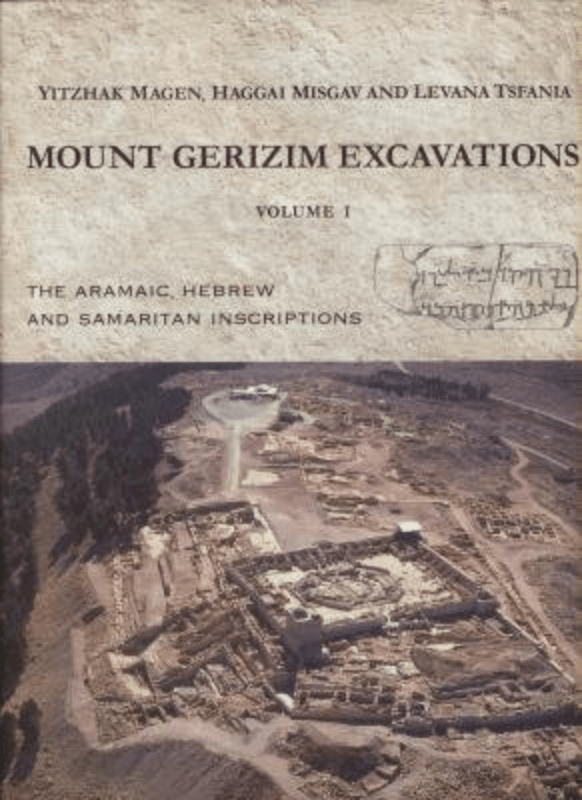
  • Magen, Yitzhak, Haggai Misgav, and Levana Tsfania. Mount Gerizim Excavations. Volume I: The Aramaic, Hebrew and Samaritan Inscriptions. Translated by Edward Levin and Michael Guggenheimer. JSP Series 2. Israel Antiquities Authority, 2004.

On page 12 Magen writes,

The archaeological finds prove that Josephus was indeed mistaken in ascribing the construction of the temple to the days of the fourth century BCE Sanballat, Alexander’s contemporary.

That remark pulled me up because I thought I had been reading carefully up to that point and could not recall reference to such probative archaeological finds. Was Magen going to list those finds later? A review of the table of contents and other skimming left me thinking there was no room for a later explanation. Perhaps the evidence would be covered in later volumes. But till then, it appeared that Magen was referring to what the reader should already know. So I re-read the preceding pages and took closer note of this passage (my bolding):

The many coins and pottery vessels discovered in the  sacred precinct attest to the construction of the temple in the Persian period, during the fifth century BCE. The finds include pottery, as well as 68 coins from the  fifth and fourth centuries BCE (preceding the arrival  of Alexander the Great in the Land of Israel).

The  earliest coin dates from 480 BCE. The temple on Mt. Gerizim was thus built in the  days of Sanballat the Horonite (Sanballat I), governor  of Samaria in the days of Nehemiah, who arrived in  the Land of Israel in 444 BCE (Neh. 2:1-10).[4]

I re-read pages 1 to 10 again – and again. How could coins and pottery vessels in themselves stand as witnesses to a temple nearby? On page 1 Magen had written that

A sacred precinct with a temple to the God of Israel that was built in the Persian period, during the fifth century BCE, stands on the highest part of the  mountain.

(We will see in a future post how Magen finds other ways of interpreting the significance of what coin finds indicate when they are not needed to somehow witness to a nearby temple.)

I was still looking forward to reading the supporting evidence for that temple. On page 3 I read the following:

The sacred precinct, centered around the temple, was built on the highest point on the mountain . . . . The excavations revealed two main  construction phases: the precinct and the temple were  first built in the fifth century BCE, during the Persian  period . . . .

Still waiting for the evidence for this temple. First, a description of the sacred precinct itself is presented:

The early precinct measured 98×96 m. . . . , including the gates. This square structure was built of hewn fieldstones extracted from  the mountain’s exposed upper strata of rock. . . .

The rooms around the inside of  the precinct wall are reminiscent of the open-roofed  chambers and courtyards mentioned in Ezekiel,  in whose vision of the Temple in Jerusalem they  were used by the Temple officiaries for cooking the  sacrifices brought by the people (Ez. 46:22-24).

The structure of the Persian period precinct, in particular the six-chambered gates, bear a resemblance  to the description of the Temple in Ezekiel (ch. 42) and to that of the future Temple in the Temple Scroll found  at Qumran, which is itself based to some extent on  Ezekiel’s description. The consistency of the remnants  of the sacred precinct on Mt. Gerizim with the  descriptions of the Temple in these two sources would  seem to support the claim by Josephus that the temple  on Mt. Gerizim was constructed on the model of the Temple in Jerusalem (Ant. 13:256).[5]

Your mileage may differ from mine, but I don’t see how such comparisons with the Book of Ezekiel (otherwise unattested until the Hellenistic period) and its vision of a wall and cooking rooms can confirm the existence of a Temple within those walls in the Persian period. My difficulty in agreeing with Magen’s method here is compounded by the fact that he had already stated – twice – that that wall had even been “rebuilt” in Hellenistic times:

In the third century BCE, in the Hellenistic  period, the temple and the sacred precinct were  rebuilt . . . .[6]

In the Hellenistic period, under Seleucid rule (early  second century BCE) the precinct and temple were  rebuilt.[7]

If the evidence for the existence of that “rebuilt” temple and its supposedly related wall were more secure for the Hellenistic era, would not that kind of archaeological evidence stand in favour of Russell Gmirkin’s hypothesis? So far Magen has failed to provide any material evidence for the existence of a temple in the Persian period. Suggesting that the evidence we do have belongs to the “rebuilt” wall in the Hellenistic period does not provide strong help for his case.

But I continue to re-read these first ten pages looking for “other evidence” for this temple that I may have missed. Here is the next item:

A great number of finds were discovered on Mt. Gerizim, including hundreds of thousands of burnt animal bones inside thick layers of ash, thus testifying  to the existence of a temple dedicated to the God of  Israel in which sacrifices were offered.[8]

No date is cited for those bones but I suspect they would include the sacrifices offered throughout the Hellenistic era. There are other questions arising, too. Magen explains in a later publication (JSP vol 7) that sacrifices were performed at a variety of sacred sites and not only at temples:

We may assume that the Jewish and Samaritan communities in Egypt and in other places of exile continued to worship YHWH at some sort of altar or temple. The sole acceptable fashion of worshiping a deity, whether YHWH or some other god, was by the construction of altars, shrines, and temples and offering sacrifices and burning incense.[9]

So remains of sacrificed animals are not necessarily evidence for a temple at all.

I also fail to see how one could determine the god to whom the animals were sacrificed from the bones themselves. After all, we do know that Yahweh-worshiping contemporaries with close relations to the Samaritans during the Persian period worshiped Yahweh alongside other deities. See the post Comparing Samaria and Judah/Yehud – and their religion – in Persian Times for details.

Magen cites late rabbinical and biblical sources to explain the meaning of other finds on Mount Gerizim. There were many bathtubs in private houses and these are presented as evidence that priests were following the Pentateuchal laws for priests to maintain purity when at the temple:

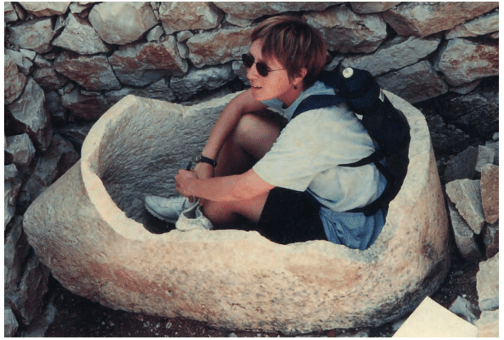
According to the Pentateuch ritual cleansing is performed by bathing in water . . .  (Lev. 14:8 et passim). . . . . It would thus seem that the many bathtubs found on Mt. Gerizim were intended for the use of the temple priests, who were required to remain in a state of ritual purity at all times, not only when serving in the temple.[10]

bath
A co-author [Gabriela Bijovsky] of JSP 19 sitting in one of the bathtubs. These bathtubs contrast with the later style of ritual baths associated with synagogues from the Hellenistic era onwards. The ritual baths include steps so one could descend for complete immersion.

[11]

Finally, we have another “proof” of the observance of biblical laws – and by implication the Persian period existence of the ideology we read about in Deuteronomy:

The finds on Mt. Gerizim indicate very strict observance of the commandment “You shall not make  for yourself an idol” (Ex. 20:4). No human or animal  images of any kind were unearthed in the excavations . . . [12]

Except that Magen appears to have changed his mind shortly afterwards (in JSP 8) when he wrote, instead, that:

it appears that the prohibition of graven images and likenesses was not scrupulously observed during the Persian period. This is evident in the material culture of the time, such as the images on coins from this period, both Samaritan and Jewish.[13]

As noted above (see note 4) the earliest coin is dated 480 BCE. Here is a photograph of that coin (not provided by Magen) held in the British Museum:

coin
Obverse: Head of lion facing left with open jaws Reverse: Ankh symbol in incuse square with spray of three leaves in each corner [14]

[15]

A graven image of a lion and an Egyptian ankh! Hardly indicators that they marked the presence of the Deuteronomist’s Temple! And apparently dated 480 BCE though of course we have no way of knowing how many hands it had felt and purses it had inhabited before it found its way to Mount Gerizim.

But we are moving away from the first of several readings Magen advised for us. In the next post we will look at more of Magen’s “extensive” evidence for the temple on Mount Gerizim in the Persian period.

Notes

[1] Peter Kirby, “When was the pro-Gerizim book of Deuteronomy written?,” Biblical Criticism & History Forum, September 19, 2025, https://earlywritings.com/forum/viewtopic.php?t=14343.

[2] John Merrill, “Dating of Samaritan Temple on Mt. Gerizim. Merrill’s Letter,” Biblical Archaeology Society, September 6, 2012, https://www.biblicalarchaeology.org/scholars-study/merrills-letter/.

[3] Yitzhak Magen, “Dating of the Samaritan Temple on Mt. Gerizim. Yitzhak Magen’s Response,” Biblical Archaeology Society, September 6, 2012, https://www.biblicalarchaeology.org/scholars-study/magens-response/.

[4] Yitzhak Magen et al., Mount Gerizim Excavations. Volume I: The Aramaic, Hebrew and Samaritan Inscriptions, trans. Edward Levin and Michael Guggenheimer, JSP Series vol. 2 (Israel Antiquities Authority, 2004), 10.

[5] Magen et al., Mount Gerizim Excavations. Volume I, 6.

[6] Magen et al., Mount Gerizim Excavations. Volume I, 1.

[7] Magen et al., Mount Gerizim Excavations. Volume I, 6.

[8] Magen et al., Mount Gerizim Excavations. Volume I, 9.

[9] Yitzhak Magen, The Samaritans and the Good Samaritan, JSP Series vol. 7 (Israel Antiquities Authority, 2008), 14.

[10] Magen et al., Mount Gerizim Excavations. Volume I, 10.

[11] Yitzhak Magen, Mount Gerizim Excavations III The Coins, JSP Series vol. 19 (Israel Antiquities Authority, 2022), 83.

[12] Yitzhak Magen et al., Mount Gerizim Excavations. Volume I: The Aramaic, Hebrew and Samaritan Inscriptions, trans. Edward Levin and Michael Guggenheimer, JSP Series vol. 2 Judea and Samaria Publications 2 (Israel Antiquities Authority, 2004), 10.

[13] Yitzhak Magen, Mount Gerizim Excavations. Volume II, A Temple City, trans. Edward Levin and Carl Ebert, JSP Series vol. 8 (Israel Antiquities Authority, 2008), 153.

[14] Magen, Mount Gerizim Excavations. Volume II, A Temple City, 194.

[15] Sir George Francis Hill, Catalogue of the Greek Coins of Cyprus (The Trustees, 1904), Plate XIII.