2016-02-07

Scholars Doing Over Lay Readers with Apologetics

Creative Commons License
This work is licensed under a Creative Commons Attribution 4.0 International License.

by Neil Godfrey

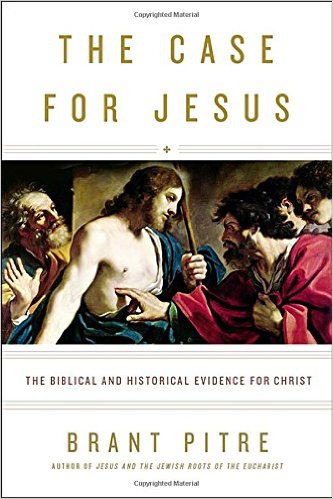
pitreA few pebbles dropped (by Michael BirdJames McGrath, Anthony Le Donne and Brant Pitre) into the pond of bible studies blogs alerting me to a new book by Brant Pitre, Professor of Sacred Scripture at Notre Dame Seminary in New Orleans. Brant Pitre recently joined The Jesus Blog as a regular contributor alongside James Crossley, Anthony Le Donne, Chris Keith, Christine Jacobi and most recently Rafael Rodríguez. The new book is “not written for scholars” (p. 10) but the blurb recommendations do assure us that

  • it “will benefit both scholars and laymen who read it” (Trent Horn),
  • its author “has a unique talent for putting scholarly work of the highest caliber into an accessible and engaging form” (Mary Healy),
  • it is the work of “wide-ranging research and careful rethinking” (Craig Keener),
  • it is an “important book” written by “one of America’s most brilliant young scholars” (Chris Tilling),
  • it’s content is “all supported by top-notch scholarship.” (Nicholas Perrin).

So scholarly book-lover that I am I grabbed a copy and started reading. I could not put it down. I’m normally a slow reader of scholarly books, taking time to check and follow up footnotes, backtracking to be sure I am registering the flow of argument, etc. But I finished The Case for Jesus: The Biblical and Historical Evidence for Christ all within a few hours.

The experience reminded me of delving into books published by my old religious cult many years ago, proving decisively and with impeccable logic and thorough research that the Bible really was the word of God, genuine scholarship proved that fact, and all modern scholarship that cast doubts on this was under the sway of the stubborn minds who refused to read the evidence seriously and foolishly relegated the Gospels to folklore and fairy tales. Form criticism was likened to the folly of that favourite juvenile Telephone Game that only works because the players don’t take the message they are asked to relay seriously and make up any old thing as they pass it along.

Now there’s nothing wrong with having a difference of opinion, or interpretation of the evidence. But a scholar surely has a responsibility to treat lay readers with enough respect to keep them informed of where his or her views sit in relation to those of his or her peers. I once asked a linguist about a particular theory of the nature of language and he began his response with, “Well, it depends who you ask….” He did not give me his own view as if it was “the truth”. He told me a range of views and the basic reasons for each and then gave his own. That’s how a scholar shows a lay person respect.

It’s not like that among some biblical scholars. Some of them, like Brant Pitre, take the opportunity to deliver a propaganda message and try to convert you to their belief system. Along they way they invite you to scoff at other scholars who disagree. They are write dogmatically, fanning dogmatism among readers.  Continue reading “Scholars Doing Over Lay Readers with Apologetics”


2014-12-30

The Churlishness of a Christian Soldier Scholar

Creative Commons License
This work is licensed under a Creative Commons Attribution 4.0 International License.

by Neil Godfrey

John Dickson
John Dickson

I was appalled to read the following on Raphael Lataster’s Facebook page just now. Raphael Lataster, we recall, was the author of the Washington Post article questioning the existence of Jesus. The article was also on the scholarly blog, The Conversation. See The Jesus Myth Question Comes to The Washington Post. John Dickson is a reasonably well-known Australian Christian evangelical apologist who once taught Raphael in a class on “The Historical Jesus to the Written Gospels” at Sydney University.

Incensed, John Dickson wrote a piece for the Australian national broadcaster, It’s Beginning to Look a lot Like Christmas … Mythicism’s in the Air.

In response James McGrath predictably jumped on the opportunity to fan more flack against mythicism with A Professor on His Mythicist Former Student. He singled out this little misleading piece:

As his former lecturer, I am somewhat embarrassed to admit that Raphael’s 1000 words on Jesus would not receive a pass mark in any history class I can imagine, even if it were meant to be a mere “personal reflection” on contemporary Jesus scholarship. Lataster is a better student than his piece suggests. But the rigours of academia in general – and the discipline of history, in particular – demand that his numerous misrepresentations of scholarship would leave a marker little choice but to fail him.

Misleading? Raphael was not writing a “history” essay and he was not so much addressing “scholarship” as he was unaddressed questions relating to the evidence. But Tertullian-like misrepresentation is par for the course in this business. (I have read two of Dickson’s books on “history” and have found them too shallow and trite to bother posting about here. Maybe I should.)

Anyway, this is the disturbing development I have just read on Raphael’s Facebook page: [* 8th January 2014 I was notified the following was a misunderstanding; John Dickson had not defriended Raphael as it appeared. See comment by Andy.]

Raphael Lataster
December 26 at 8:13pm ·

John Dickson surprisingly (we have always been very friendly) defriended me after he wrote a (grossly inaccurate) reply article to my own on Jesus’ possible ahistoricity, and continues to refuse to debate with me on Jesus’ resurrection (i.e. the Jesus he actually believes in). I would think that believers would relish the chance to show their courage and defend their faith. I’m not that scary… If anyone would like to see this debate happen, do let John and I know. John’s contact: Continue reading “The Churlishness of a Christian Soldier Scholar”


2012-03-26

The Democratization of Knowledge and the Reaction of Reactionary Scholars

Creative Commons License
This work is licensed under a Creative Commons Attribution 4.0 International License.

by Tim Widowfield

Today’s scripture reading comes from Ring Lardner’s short story, “The Young Immigrunts.”


Chapter 10

N.Y. TO GRENITCH 500.0

The lease said about my and my fathers trip from the Bureau of Manhattan to our new home the soonest mended. In some way ether I or he got balled up on the grand concorpse and next thing you know we was thretning to swoop down on Pittsfield.

Are you lost daddy I arsked tenderly.

Shut up he explained.


Balled Up on the Grand Concorpse

photograph of stained glass window in St. Igna...
photograph of stained glass window in St. Ignatius Church, Chestnut Hill, Massachusetts by John Workman (Photo credit: Wikipedia)

Everybody else in the world has been blogging about Dr. Bart Ehrman’s latest book on the existence of Jesus, and I didn’t want to feel left out. But the truth is there’s not much left to say. Yes, it’s a disappointment. And yes, we expected more and better from a respected, popular scholar. On the other hand, it wasn’t that big a surprise, was it?

We might, however, be forgiven if we found the tone of the debate a tad over the top. We have learned, as the hapless four-year-old protagonist in Lardner’s story discovered, that there is no way to ask Daddy if he’s lost that won’t bring a harsh response.

It does seem odd, however, to see scholars with advanced degrees — public intellectuals who teach real students at real universities — stooping to personal attacks. More disturbing than the abuse is the apparent lack of unawareness exhibited by the perpetrators, as if to say, “This is perfectly normal behavior.” Continue reading “The Democratization of Knowledge and the Reaction of Reactionary Scholars”


2011-09-29

Keeping (Biblical) Scholars Honest

Creative Commons License
This work is licensed under a Creative Commons Attribution 4.0 International License.

by Neil Godfrey

In a recent post I drew attention to Mark Goodacre’s remark that the work of the mythicists helps keeps “scholars like him honest”. It is always good, he said, to go back and see how we really do know that Jesus existed. But is that what they are doing? Why are New Testament scholars failing to cope with the new potentials and challenges of the internet in the same way that scholars from certain other disciplines are?

One of the best things that has happened to challenge scholars in recent years is the internet and the internet’s potential to democratize knowledge as well as challenges to established conventional wisdoms.

One still sees a few scholars complaining about the internet’s ability to pollute, dilute, dispute, disrepute, confute and prostitute all that is holy and good in their field of research.

Some woolly mammoths are even still caught out poo-poohing Wikipedia on principle simply because it started out as a democratically created encyclopedia. Even when they do mention it favourably they betray their guilt by adding some scoffing remark like a mantra. (See http://www.nature.com/nature/journal/v438/n7070/full/438900a.html and related links for comparison of Wikipedia with Encyclopedia Britannica)

I have not done a study of who the main culprits of all this esoteric anti-democratic fear-mongering are, but I do wonder if most of them belong to the non-science fields. Continue reading “Keeping (Biblical) Scholars Honest”


2011-07-16

“Pseudo-scholarship” – such comments do not belong in scholarly writing or debate

Creative Commons License
This work is licensed under a Creative Commons Attribution 4.0 International License.

by Neil Godfrey

After discussing fundamentalist approaches to the Bible — whether fundamentalism on the part of Bible believers or fundamentalism on the part of Bible denigrators — Lester Grabbe concludes:

There is no permanent state of purity nor any established chair of righteousness in scholarship. Even if one suspects that a scholarly position or theory is ideologically motivated — whether from biblical fundamentalism or some other ideology — one should evaluate the position on the basis of stated arguments. Trying to second guess motives has become too much of a pastime in the academy. (p. 23 of Ancient Israel: What Do We Know and How Do We Know It?, my emphasis)

Is there anyone out there who has a history of imputing anti-Christian vendettas to mythicists reading this? Does the shoe fit?

Lester Grabbe continues:

It has become common in recent years to introduce personal motives into arguments: ‘so and so takes this position because he/she is/thinks/believes this or that’. Unfortunately, we can always find reasons to say that someone takes a scholarly position because of personal or ideological motives . . . . Such statements have no place in scholarly argument. In fact, there is probably not a one of us who has not taken a position on some issue for personal reasons, even if totally unconscious of this motive. . . . I am very sensitive to arguments or positions that seem to arise from a fundamentalist stance with regard to the Bible. Yet, as John Emerton once remarked from the floor in a conference, we should reply to the specific arguments rather than what we think might be behind them. . . . (p. 24)

Grabbe discusses an article attacking another that dated the Siloam inscription to the Maccabaean period. The attacking article was headlined “Pseudo-Scholarship”. Grabbe says that this article made some relevant and serious points, but the heading of “Pseudo-Scholarship”

served to prejudice the readership from the start. The redating of the Siloam inscription may be wrong — and most so far think it is — but it is not “pseudo-scholarship”, and such ad hominem comments do not belong in scholarly writing or debate. (pp. 24-5)

If Lester Grabbe has a point, and he probably does, then I have to confess guilt on this count, too. Let’s see what happens from now on.


2011-05-29

The aim of name-calling

Creative Commons License
This work is licensed under a Creative Commons Attribution 4.0 International License.

by Neil Godfrey

Why do some people stoop to insult when attacking mythicists? Educational psychology guides us to win over those we wish to persuade by showing them respect and using the tools of hard facts, research, and to trust the judgment of an audience to make sensible decisions once offered all the available information. That’s what makes genuine education — including public education as we encounter here online — different from propaganda.

Niels Peter Lemche was not addressing attacks on mythicism, but his criticisms of the way scholars who should know better stoop to unprofessional snide attacks against minimalists do apply nonetheless.

Some excerpts: Continue reading “The aim of name-calling”


2010-10-27

The Tactics of Conservative Scholarship (according to J. Barr & N-P. Lemche)

Creative Commons License
This work is licensed under a Creative Commons Attribution 4.0 International License.

by Neil Godfrey

Diversionary tactics
Image by tompagenet via Flickr

In 2003 Niels-Peter Lemche posted a blunt article addressing the unscholarly tactics of conservative scholars. He noted how even historical-critical scholars had come to resort to the same polemics as conservatives in their efforts to “crush so-called ‘radical’ critical scholarship.”

There may be a number of explanations for this strange fact. One may be that the majority of critical scholars originate within a religious milieu and at the bottom of their hearts are conservatives without probably realizing this. Thus, critical scholarship represents a kind of breaking away from one’s own background. The changing attitude towards even more critical scholars questioning, e.g., the very existence of King David, may have to do with the fear of totally losing the tradition-after all Joseph and Mary went to Bethlehem so the new David could be born there! Somehow there seem to be questions that we are not allowed to ask.

The above is cited from Niels Peter Lemche’s 2003 post, Conservative Scholarship-Critical Scholarship: Or How Did We Get Caught by This Bogus Discussion on Bible and Interpretation.

Surely we find the same motives for these same tactics among those biblical scholars who are most vociferous in their polemics against the very idea of questioning the existence of Jesus Christ, also.

I quote sections from Lemche’s article here that look very like the same sized shoe that fits the reactions of biblical scholars against Christ-mythicism. Continue reading “The Tactics of Conservative Scholarship (according to J. Barr & N-P. Lemche)”