
This post follows on from An Attempt to Date a pro-Samarian Deuteronomy to the Persian Period — which in turn was a response to When was the pro-Gerizim book of Deuteronomy written?
As a rule of thumb it is not a bad idea to consult scholarly authorities to learn “what’s what”. But scholars are also human and fallible, and sometimes have their own agendas that they attempt to push on less than attentive readers. So another rule, more precise than measurement by random thumbs, is this: it is an even better idea when consulting scholarly authorities to be alert for the evidence they cite to support their “what’s whats”.
That little gem of wisdom came to me when I noticed a case for the Book of Deuteronomy, at least in some early Samaritan form, being composed in Persian times. The starting point of the Persian period argument was to appeal to the authoritative declarations of an archaeologist who has had the Albrightian habit of interpreting archaeological finds in ways that would ensure confirmation of some plausible interpretation of biblical narratives.
To argue, against Gmirkin, that the Book of Deuteronomy was composed well before the Greeks, indeed in those Persian times we associate with Haggai and Zechariah, Nehemiah and Ezra, the claim was made that it was in significant part written against the backdrop of a Temple to Yahweh on Mount Gerizim in Samaria. Deuteronomy’s insistence that only one place of worship was permitted, along with the various other purity laws, rituals and commandments, all made sense given the authoritative assurance of a standing Temple. (For an explanation of how it was Deuteronomy that came to be specifically related to the Samaritan temple see an earlier post: The Samaritan Tenth Commandment.)
But alas, the opening line of that argument is an appeal to authority but when we look for the supporting evidence we find nothing but dust and ashes being scattered in the wind.
Here is the beginning of the argument per the earlywritings forum:[1]
From Yitzhak Magen, regarding the temple at Gerizim (ca. 475-445 BCE, i.e. the “middle” and before 445 BCE), based on archaeological excavations:
The archaeological excavations at Mt. Gerizim proved unequivocally that the temple on the mount was built in the middle of the fifth century B.C.E., that is, most likely before Nehemiah’s arrival in 445 B.C.E.
It is always handy to have an overpowering descriptor like “unequivocally” when one fails to provide specific evidence. And it is specific evidence that another scholar had asked of Yitzhak Magen:
I have a question . . . . Magen states that his excavations reveal that the Temple on Gerizim was built in the time of Nehemiah . . . . It seems to me that the archaeological evidence for a fifth-century date would have to be quite powerful to overcome the documentary evidence. And since there is nothing remaining of the Gerizim temple itself . . . . . strong archaeological evidence for the earlier date would be most enlightening.[2]
Magen responded with his “proved unequivocally” declaration quoted above. He indicated that the proofs were so “extensive” that they could not be summarized briefly but required the reading of three books and additional articles:
Extensive answers to the questions raised in this letter can be found in three books published in the JSP series (Judea and Samaria Publications, volumes 2, 7 and 8), and in additional articles, all in English.[3]
“More specifically”, Magen continued, there is an argument he derives from a reinterpretation of details found in the Book of Nehemiah. I will set that argument aside because it reminds us of the bad old days when “biblical archaeologists” were notorious for finding ways to interpret archaeological finds that marvellously “proved” some particular interpretation of the Bible. We have no independent evidence to confirm that Nehemiah has any serious relationship to historical events of the Persian period, however the text is interpreted. Until such evidence is forthcoming it is best to guard against interpreting the archaeological evidence tendentiously in the light of the Bible. (I have discussed scholarly critiques of the historical value of Nehemiah “extensively” on this blog: search “Nehemiah” alone for core arguments and then “Nehemiah and Finkelstein” for additional archaeologically-based criticisms.)
So let’s assume that the archaeological evidence for a Mount Gerizim Temple in the Persian period is so vast and overwhelming that one can only grasp it by reading three volumes and various articles. I will for most part therefore confine the following discussion to the works Magen signalled:
- JSP series, volumes 2, 7 and 8;
- and perhaps then additional articles of his in English
JSP Series, Volume 2
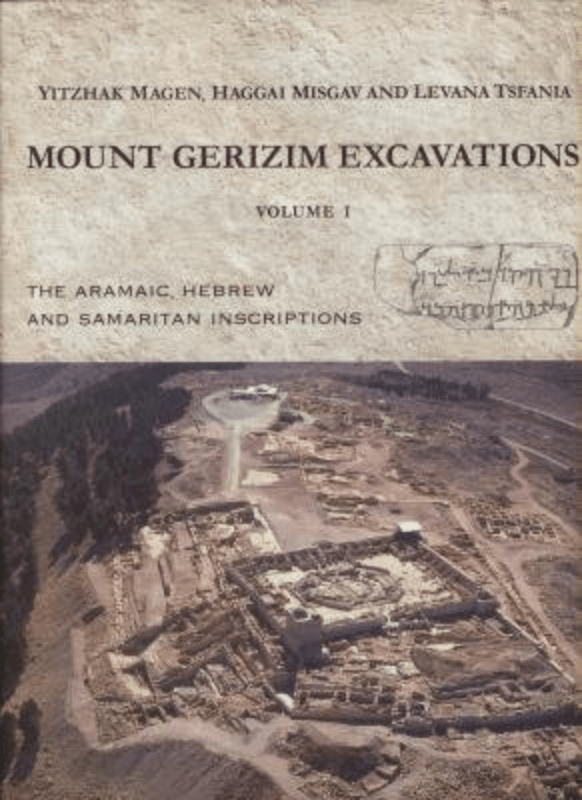 More completely referenced, this work is
- Magen, Yitzhak, Haggai Misgav, and Levana Tsfania. Mount Gerizim Excavations. Volume I: The Aramaic, Hebrew and Samaritan Inscriptions. Translated by Edward Levin and Michael Guggenheimer. JSP Series 2. Israel Antiquities Authority, 2004.
On page 12 Magen writes,
The archaeological finds prove that Josephus was indeed mistaken in ascribing the construction of the temple to the days of the fourth century BCE Sanballat, Alexander’s contemporary.
That remark pulled me up because I thought I had been reading carefully up to that point and could not recall reference to such probative archaeological finds. Was Magen going to list those finds later? A review of the table of contents and other skimming left me thinking there was no room for a later explanation. Perhaps the evidence would be covered in later volumes. But till then, it appeared that Magen was referring to what the reader should already know. So I re-read the preceding pages and took closer note of this passage (my bolding):
The many coins and pottery vessels discovered in the sacred precinct attest to the construction of the temple in the Persian period, during the fifth century BCE. The finds include pottery, as well as 68 coins from the fifth and fourth centuries BCE (preceding the arrival of Alexander the Great in the Land of Israel).
The earliest coin dates from 480 BCE. The temple on Mt. Gerizim was thus built in the days of Sanballat the Horonite (Sanballat I), governor of Samaria in the days of Nehemiah, who arrived in the Land of Israel in 444 BCE (Neh. 2:1-10).[4]
I re-read pages 1 to 10 again – and again. How could coins and pottery vessels in themselves stand as witnesses to a temple nearby? On page 1 Magen had written that
A sacred precinct with a temple to the God of Israel that was built in the Persian period, during the fifth century BCE, stands on the highest part of the mountain.
(We will see in a future post how Magen finds other ways of interpreting the significance of what coin finds indicate when they are not needed to somehow witness to a nearby temple.)
I was still looking forward to reading the supporting evidence for that temple. On page 3 I read the following:
The sacred precinct, centered around the temple, was built on the highest point on the mountain . . . . The excavations revealed two main construction phases: the precinct and the temple were first built in the fifth century BCE, during the Persian period . . . .
Still waiting for the evidence for this temple. First, a description of the sacred precinct itself is presented:
The early precinct measured 98×96 m. . . . , including the gates. This square structure was built of hewn fieldstones extracted from the mountain’s exposed upper strata of rock. . . .
The rooms around the inside of the precinct wall are reminiscent of the open-roofed chambers and courtyards mentioned in Ezekiel, in whose vision of the Temple in Jerusalem they were used by the Temple officiaries for cooking the sacrifices brought by the people (Ez. 46:22-24).
The structure of the Persian period precinct, in particular the six-chambered gates, bear a resemblance to the description of the Temple in Ezekiel (ch. 42) and to that of the future Temple in the Temple Scroll found at Qumran, which is itself based to some extent on Ezekiel’s description. The consistency of the remnants of the sacred precinct on Mt. Gerizim with the descriptions of the Temple in these two sources would seem to support the claim by Josephus that the temple on Mt. Gerizim was constructed on the model of the Temple in Jerusalem (Ant. 13:256).[5]
Your mileage may differ from mine, but I don’t see how such comparisons with the Book of Ezekiel (otherwise unattested until the Hellenistic period) and its vision of a wall and cooking rooms can confirm the existence of a Temple within those walls in the Persian period. My difficulty in agreeing with Magen’s method here is compounded by the fact that he had already stated – twice – that that wall had even been “rebuilt” in Hellenistic times:
In the third century BCE, in the Hellenistic period, the temple and the sacred precinct were rebuilt . . . .[6]
In the Hellenistic period, under Seleucid rule (early second century BCE) the precinct and temple were rebuilt.[7]
If the evidence for the existence of that “rebuilt” temple and its supposedly related wall were more secure for the Hellenistic era, would not that kind of archaeological evidence stand in favour of Russell Gmirkin’s hypothesis? So far Magen has failed to provide any material evidence for the existence of a temple in the Persian period. Suggesting that the evidence we do have belongs to the “rebuilt” wall in the Hellenistic period does not provide strong help for his case.
But I continue to re-read these first ten pages looking for “other evidence” for this temple that I may have missed. Here is the next item:
A great number of finds were discovered on Mt. Gerizim, including hundreds of thousands of burnt animal bones inside thick layers of ash, thus testifying to the existence of a temple dedicated to the God of Israel in which sacrifices were offered.[8]
No date is cited for those bones but I suspect they would include the sacrifices offered throughout the Hellenistic era. There are other questions arising, too. Magen explains in a later publication (JSP vol 7) that sacrifices were performed at a variety of sacred sites and not only at temples:
We may assume that the Jewish and Samaritan communities in Egypt and in other places of exile continued to worship YHWH at some sort of altar or temple. The sole acceptable fashion of worshiping a deity, whether YHWH or some other god, was by the construction of altars, shrines, and temples and offering sacrifices and burning incense.[9]
So remains of sacrificed animals are not necessarily evidence for a temple at all.
I also fail to see how one could determine the god to whom the animals were sacrificed from the bones themselves. After all, we do know that Yahweh-worshiping contemporaries with close relations to the Samaritans during the Persian period worshiped Yahweh alongside other deities. See the post Comparing Samaria and Judah/Yehud – and their religion – in Persian Times for details.
Magen cites late rabbinical and biblical sources to explain the meaning of other finds on Mount Gerizim. There were many bathtubs in private houses and these are presented as evidence that priests were following the Pentateuchal laws for priests to maintain purity when at the temple:
According to the Pentateuch ritual cleansing is performed by bathing in water . . . (Lev. 14:8 et passim). . . . . It would thus seem that the many bathtubs found on Mt. Gerizim were intended for the use of the temple priests, who were required to remain in a state of ritual purity at all times, not only when serving in the temple.[10]
Finally, we have another “proof” of the observance of biblical laws – and by implication the Persian period existence of the ideology we read about in Deuteronomy:
The finds on Mt. Gerizim indicate very strict observance of the commandment “You shall not make for yourself an idol” (Ex. 20:4). No human or animal images of any kind were unearthed in the excavations . . . [12]
Except that Magen appears to have changed his mind shortly afterwards (in JSP 8) when he wrote, instead, that:
it appears that the prohibition of graven images and likenesses was not scrupulously observed during the Persian period. This is evident in the material culture of the time, such as the images on coins from this period, both Samaritan and Jewish.[13]
As noted above (see note 4) the earliest coin is dated 480 BCE. Here is a photograph of that coin (not provided by Magen) held in the British Museum:

A graven image of a lion and an Egyptian ankh! Hardly indicators that they marked the presence of the Deuteronomist’s Temple! And apparently dated 480 BCE though of course we have no way of knowing how many hands it had felt and purses it had inhabited before it found its way to Mount Gerizim.
But we are moving away from the first of several readings Magen advised for us. In the next post we will look at more of Magen’s “extensive” evidence for the temple on Mount Gerizim in the Persian period.
Notes
[1] Peter Kirby, “When was the pro-Gerizim book of Deuteronomy written?,” Biblical Criticism & History Forum, September 19, 2025, https://earlywritings.com/forum/viewtopic.php?t=14343.
[2] John Merrill, “Dating of Samaritan Temple on Mt. Gerizim. Merrill’s Letter,” Biblical Archaeology Society, September 6, 2012, https://www.biblicalarchaeology.org/scholars-study/merrills-letter/.
[3] Yitzhak Magen, “Dating of the Samaritan Temple on Mt. Gerizim. Yitzhak Magen’s Response,” Biblical Archaeology Society, September 6, 2012, https://www.biblicalarchaeology.org/scholars-study/magens-response/.
[4] Yitzhak Magen et al., Mount Gerizim Excavations. Volume I: The Aramaic, Hebrew and Samaritan Inscriptions, trans. Edward Levin and Michael Guggenheimer, JSP Series vol. 2 (Israel Antiquities Authority, 2004), 10.
[5] Magen et al., Mount Gerizim Excavations. Volume I, 6.
[6] Magen et al., Mount Gerizim Excavations. Volume I, 1.
[7] Magen et al., Mount Gerizim Excavations. Volume I, 6.
[8] Magen et al., Mount Gerizim Excavations. Volume I, 9.
[9] Yitzhak Magen, The Samaritans and the Good Samaritan, JSP Series vol. 7 (Israel Antiquities Authority, 2008), 14.
[10] Magen et al., Mount Gerizim Excavations. Volume I, 10.
[11] Yitzhak Magen, Mount Gerizim Excavations III The Coins, JSP Series vol. 19 (Israel Antiquities Authority, 2022), 83.
[12] Yitzhak Magen et al., Mount Gerizim Excavations. Volume I: The Aramaic, Hebrew and Samaritan Inscriptions, trans. Edward Levin and Michael Guggenheimer, JSP Series vol. 2 Judea and Samaria Publications 2 (Israel Antiquities Authority, 2004), 10.
[13] Yitzhak Magen, Mount Gerizim Excavations. Volume II, A Temple City, trans. Edward Levin and Carl Ebert, JSP Series vol. 8 (Israel Antiquities Authority, 2008), 153.
[14] Magen, Mount Gerizim Excavations. Volume II, A Temple City, 194.
[15] Sir George Francis Hill, Catalogue of the Greek Coins of Cyprus (The Trustees, 1904), Plate XIII.
If you enjoyed this post, please consider donating to Vridar. Thanks!
Leave a Reply