
Past posts here have argued for the Biblical literature taking shape primarily in the Hellenistic era. That’s not the common view, however.
While traditional views have assigned the earliest “proto-books” to the Iron age, the time of the Kingdoms of David and Solomon, or the time of King Josiah, much of the shaping of the biblical texts is thought to have happened after the return of Judeans to the Persian province of Yehud and Jerusalem. It was in this period — the fifth and fourth centuries, the setting assigned to Ezra and Nehemiah — that scribes and priests are often thought to have engaged in selecting, collating and redacting texts into what became the Hebrew Bible.
This Persian-period and Jerusalem-centred basis for the creative activity on the biblical literature has many theoretical and hypothetical arguments underpinning it. But what happens if we take a closer look at the “facts on the ground”, as they say? What if Jerusalem at this time had all the signs of a “post-collapse society”, one in which a few score inhabitants could do little better for themselves than to live in ruins, I mean unrepaired ruins? Centres of economic activity and administration were found elsewhere: Moza, about 7 km away, has left remains of stronger economic activity; Ramat Raḥel, 3 km south, was the administrative centre of the province. Persian forts in the region were positioned to protect trade routes that bypassed Jerusalem. And not a single Hebrew inscription is to be found in Persian-period Jerusalem.
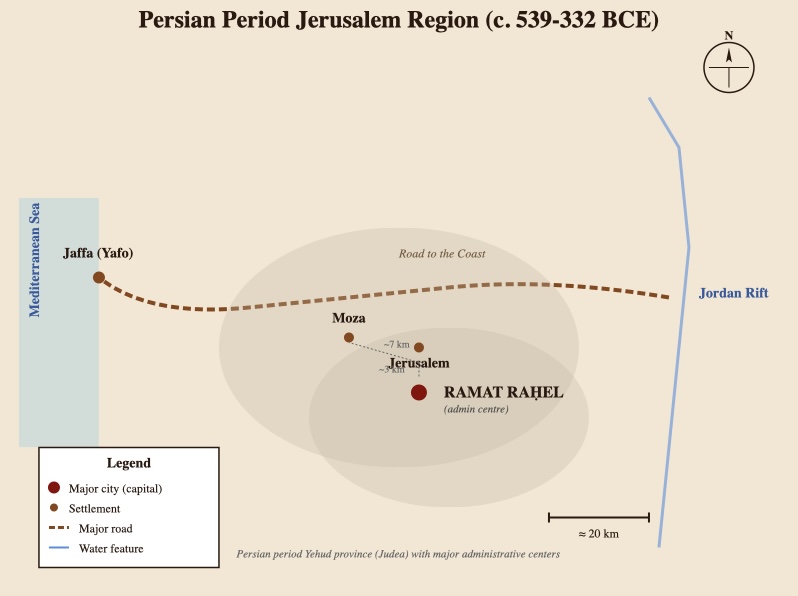
Below is an essay I wrote a month or so ago as part of a post-grad course. It discusses in depth why Jerusalem in the time of the Persian empire is not likely to have been a base for scribes engaged with work on what was to become the Hebrew Bible. (I have made only slight alterations to the original essay.) More relevant maps are included in the essay.
Leave a Reply
If you enjoyed this post, please consider donating to Vridar. Thanks!
Nice paper. No wonder there is resistance to data, the Israeli government insists that “the land” belongs to them because their god gave it to them, when it is theirs only by right of conquest, just like every other country on the planet. The devotion of modern politicians to the clearly fictional narrative in their scriptures is a tremendous barrier to break through for honest archeologists.
There is no contradiction between believing in divine promise of the land to the Israelites and the land being conquered by the Israelites. If one accepts the Biblical narrative the Israelites were only able to conquer the land (actually only parts of it) thanks to divine intervention. (And YHWH decided for reasons of his own that they would not be able to conquer the entire country. Their faith and loyalty had to be tested by the constant presence of other nations among them. Because reasons.)
The interesting thing is that archaeological evidence supports that the conquest never happened, that the iron age people who formed an increased number of permanent settlements in the hilly areas of the southern Levant were of local origin. But being a conqueror was until not long ago considered better than just living in the same place being yourself, so people invented stories of conquest for themselves.
Perfect comment.
It is a unholy set-up.
In Israel this idea unites political zionists without any religious bias — but directed enormous nationalistic egos, and so-called religious Jews willing to repeatr previous ages mistakes, a kind of inner longing for destruction…. perverse of course.
While digging at Tel Yizreel back in 1996, I gave a lecture for the kibbutzim who housed the expedition. When I told them that the was no historical Abraham and no historical Moses theu didn’t care. However, when I told them that there was no historical King David, they were very disturbed: The founder of the state of Israel.
Here you see how religion and politics join up together.
Why do you think Jesus Ben Sira has to leave Jerusalem to go to Alexandria, Egypt to write what was happening in Jerusalem and the condition of the 2nd Temple, and why his grandson had to go to Alexandria to get the Hebrew copy of what his grandfather wrote so he could translate it into Greek? Likely, because there was insufficient infrastructure in Jerusalem to be able to produce literature.
Yes, and of course I also had in mind Russell Gmirkin’s specific thesis that the biblical literature, certainly much of it, originated in Alexandria itself in the 280s BCE. And that was a full generation after the Greek conquest.
Read the appendix in my If I forget you Jerusaslem! Equinox 2024. About a terminus a quo in 272 BCE: The death of Pyrrhus during streetfighting in Argos, killed by the slab from a woman thrown from the roof of a house. In Judges this is followed by the sacrifice of the daughter of Jophtah, or rather Iphigeneia, followed again by Heracles = Samson. End of Judges, a Hebrew version of the rape of the Sabine women.
nor to overlook some rather pointed overlaps between Ovid’s Flood and that of Genesis.
I think I’m missing your point:
Ovid lived under Augustus, he would have copied Gilgamesh or Genesis not the other way round, no?
Indeed he did. It was clearly not from Ovid that the biblical author took his ideas. Nor would one think it likely that Ovid read Genesis. One is led to suspect an older source for such details in both Metamorphoses and Genesis.